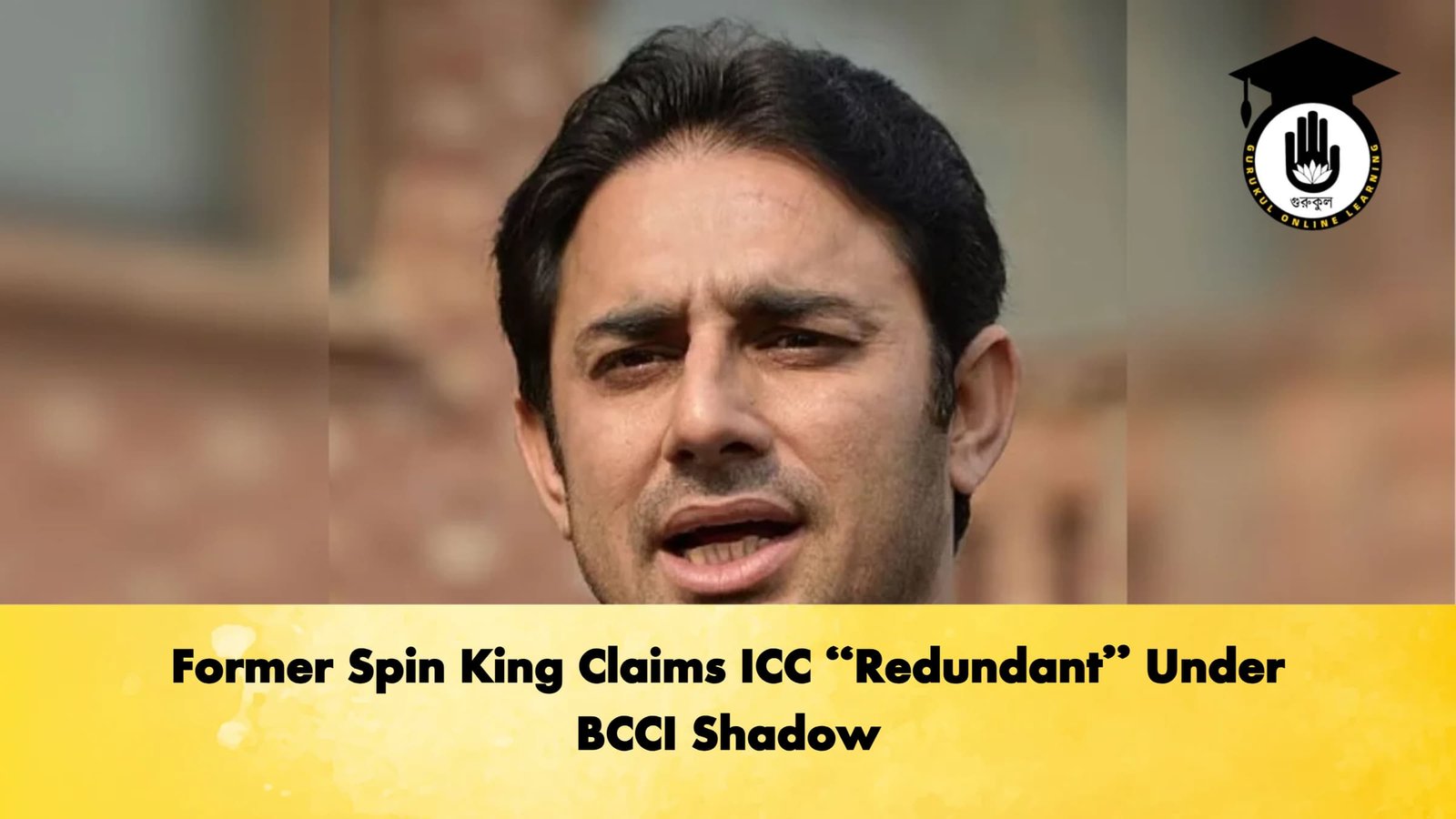
The International Cricket Council (ICC) is facing a fierce legitimacy crisis following a stinging verbal assault by former Pakistani spin maestro Saeed Ajmal. Speaking at an event in Karachi, the T20 World Cup winner questioned the very purpose of the organisation’s existence, alleging that it has become a “vassal state” to the Board of Control for Cricket in India (BCCI).
Ajmal’s critique, reported by the Press Trust of India (PTI), highlights a growing rift in the sport’s hierarchy. “If the ICC cannot operate independently of the BCCI’s influence, why does this institution even exist?” Ajmal asked. He further asserted that if the council remains “incapable of enforcing its own rules” against the wealthiest board, it should be disbanded entirely.
A Failure of Neutrality
The 48-year-old veteran, who claimed that many Test-playing nations share his views but are “too intimidated to speak up,” pointed to the fractured India-Pakistan relationship as the ultimate proof of the ICC’s impotence.
The crux of the dispute lies in India’s refusal to travel to Pakistan for multi-nation tournaments. Ajmal argues that by constantly accommodating India’s demands for neutral venues, the ICC has essentially surrendered its sovereignty. This perception was bolstered on 1 December 2024, when Jay Shah, the son of India’s Home Minister and former BCCI Secretary, took over as the Chairman of the ICC.
The Evolution of the “Hybrid Model”
The cricketing world has increasingly relied on complex logistics to manage the deadlock between the two nuclear-armed neighbours. While Pakistan travelled to India for the 2016 T20 World Cup and the 2023 ODI World Cup, India has not crossed the border since 2008.
| Tournament | Host | Status of Indo-Pak Fixture |
| 2008 Asia Cup | Pakistan | India travelled to Pakistan |
| 2023 ODI World Cup | India | Pakistan travelled to India |
| 2025 Champions Trophy | Pakistan | Hybrid: India played in Dubai |
| 2026 T20 World Cup | India/Sri Lanka | Hybrid: Pakistan to play in Sri Lanka |
Diplomatic Deadlock and Reciprocity
The situation worsened significantly following an attack in Pahalgam in April 2025, where 26 people were killed. This tragedy served to further entrench the BCCI’s “no-travel” policy. However, Pakistan has recently pivoted from its previous stance of accommodation to one of direct reciprocity.
For the T20 World Cup beginning on 7 February 2026, Pakistan has officially refused to set foot in India. Consequently, the ICC has been forced to schedule Pakistan’s matches—and their high-stakes clash against the hosts—in Sri Lanka.
The Spin King’s Stance
Saeed Ajmal, who retired in 2017 with 447 international wickets across all formats, remains one of the most respected voices in Pakistani cricket. His mastery of the “doosra” once made him the most feared bowler in the world, and his current role as a vocal critic of cricket’s administrative bias reflects a broader frustration within the global game.
As the 2026 T20 World Cup approaches, the sport finds itself at a crossroads: either the ICC regains its teeth as a neutral arbiter, or the “Hybrid Model” becomes a permanent fixture of a fractured sporting landscape.