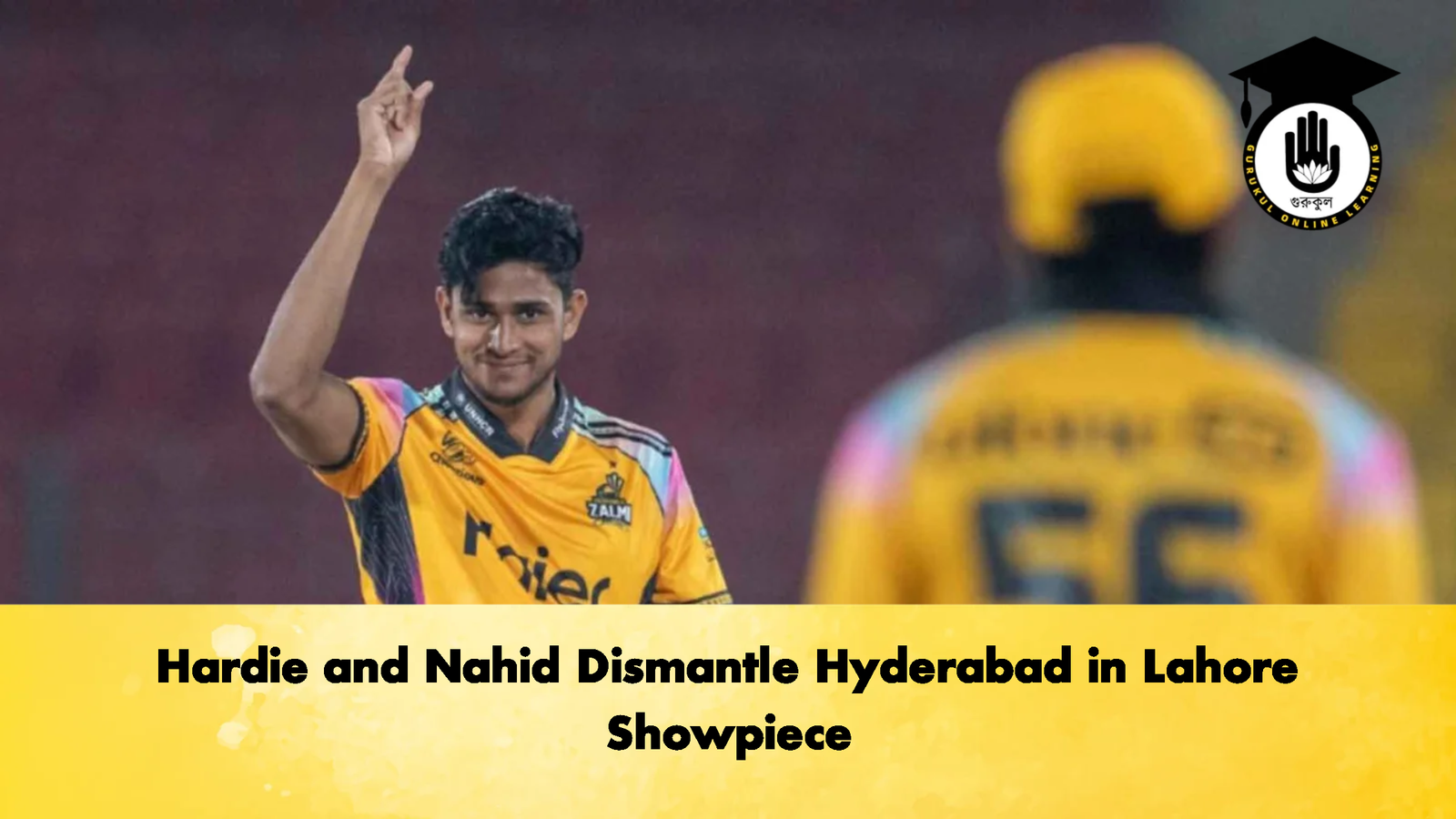
LAHORE — The Hyderabad Kingsmen failed to capitalise on a promising preliminary phase in the tournament final, ultimately being dismissed for a modest total of 129. Despite a resilient and technically proficient half-century from Saim Ayub, the middle-order proved insufficient against a relentless Peshawar bowling attack. Marnus Labuschagne’s side, having been put in to bat after losing the toss, were unable to complete their full allocation of overs, falling in the 18th over and leaving their opponents a manageable path to the title.
Hyderabad’s Early Momentum Dissipates
The match commenced with a clear display of intent from the Hyderabad opening pair. Maz Sadaqat provided a brief but aggressive cameo, striking 11 runs from a mere six deliveries. His departure, however, occurred before he could convert this momentum into a substantial contribution. Following the early loss of Sadaqat, the captain Marnus Labuschagne arrived at the crease.
The Australian international maintained a brisk scoring rate, accumulating 20 runs off 12 balls. His innings was punctuated by fluent stroke play that briefly suggested a formidable total was within reach. Nevertheless, Labuschagne was unable to sustain his presence at the crease, perishing just as the Peshawar bowlers began to find their rhythm on the Lahore surface. His exit served as the precursor to a significant period of instability within the Kingsmen’s batting ranks.
Saim Ayub’s Disciplined Resistance
Amidst the regular fall of wickets, Saim Ayub, batting at number three, provided the solitary source of sustained resistance. Displaying remarkable composure under the heightened pressure of a final, Ayub anchored the innings with a disciplined approach. He navigated the challenges posed by the Peshawar seamers, reaching a personal half-century off 42 deliveries.
Ayub eventually concluded his innings as the top scorer for Hyderabad with 54 runs. Despite his individual success, he was forced to battle largely in isolation. The lack of a secondary anchor or a meaningful partnership from the middle order meant that Ayub had to temper his natural aggression with necessary caution. Once the set batsman was eventually removed, the lower order collapsed rapidly, and the innings drew to a premature close with the scoreboard stationary at 129.
Peshawar’s Clinical Bowling Performance
The Peshawar bowling unit executed their tactical plans with precision, characterised by disciplined lines and strategic variations. The standout performer of the afternoon was Aaron Hardie, whose spell effectively dismantled the Hyderabad middle order. Hardie concluded his assignment with the exceptional figures of 4 wickets for 27 runs, striking at pivotal moments to ensure Hyderabad could never recover their equilibrium.
Complementing Hardie’s dominance was the raw pace and consistency of Nahid Rana. Rana remained a persistent threat throughout his spell, finishing with highly economical figures of 2 wickets for 22 runs. His contribution was vital in maintaining pressure and preventing the batsmen from finding any scoring rhythm. The collective bowling effort was further bolstered by Mohammad Basit and Sufiyan Muqeem, who each secured a wicket to keep the run rate suppressed.
Bowling Figures Summary:
Aaron Hardie: 4 wickets for 27 runs (Economy: 6.75)
Nahid Rana: 2 wickets for 22 runs (Economy: 5.50)
Mohammad Basit: 1 wicket
Sufiyan Muqeem: 1 wicket
Technical Review of the First Innings
The Hyderabad Kingsmen will likely view their failure to bat through the final 12 deliveries as a critical error. Being dismissed in the 18th over deprived the side of potentially 15 to 20 additional runs, which can be decisive in a low-scoring final. While their overall run rate of 7.16 per over was mathematically sound, the inability to protect wickets in the middle phase saw them fall well short of the 160-run mark that had seemed attainable during Labuschagne’s tenure.
Peshawar’s bowlers utilised the conditions in Lahore with great effect, exploiting the slight assistance offered to the seamers by maintaining a challenging length. As the match moves into the second innings, Peshawar requires 130 runs to secure the championship. Although the target is statistically modest, the inherent pressure of a final ensures that a composed and professional batting performance will be required to overhaul the total.