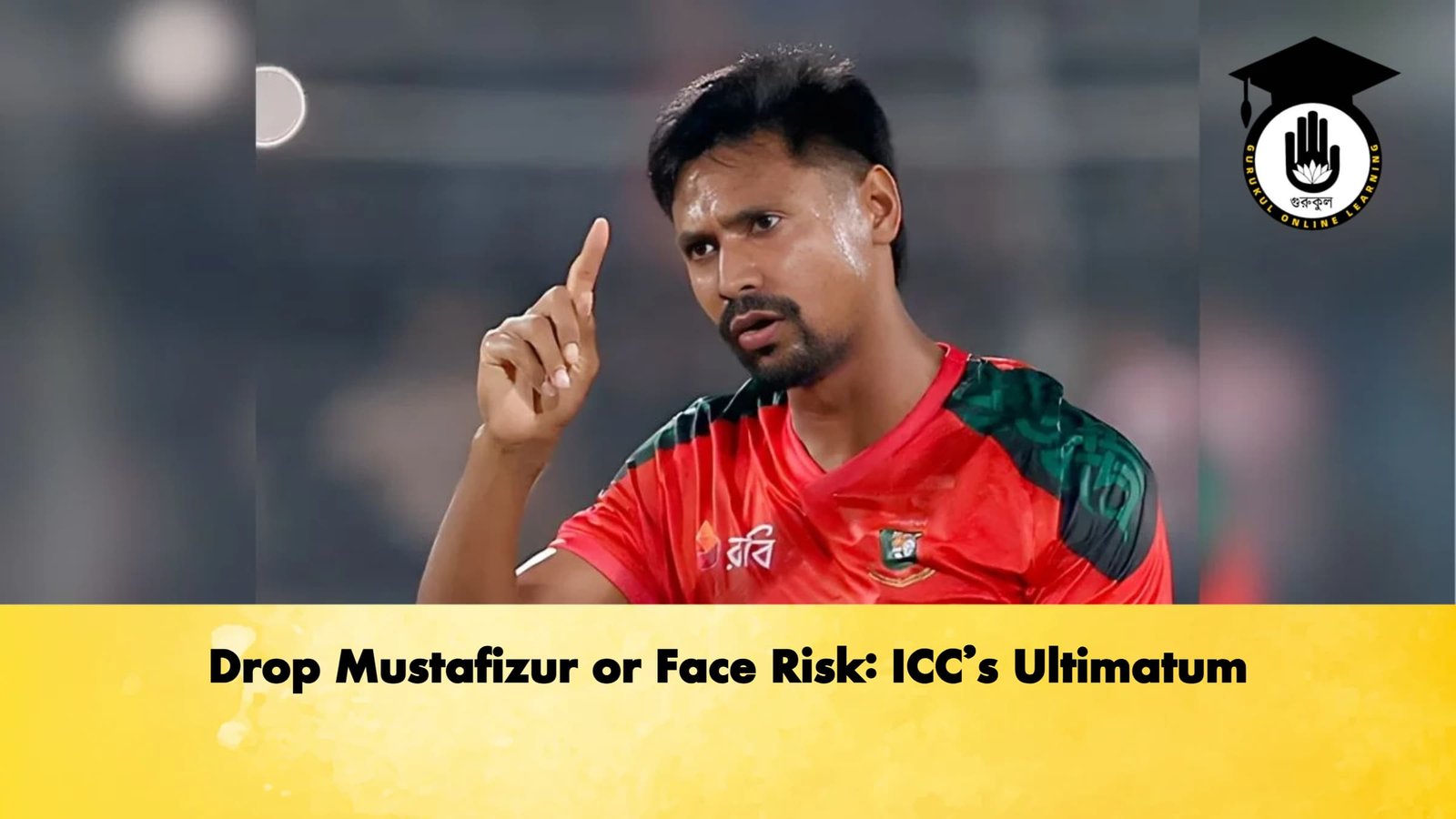
International cricket has been plunged into a diplomatic storm following a “bizarre” security assessment issued by the International Cricket Council (ICC) regarding Bangladesh’s participation in the upcoming T20 World Cup in India. In a formal communiqué, the ICC’s security department warned that the presence of star left-arm pacer Mustafizur Rahman would significantly escalate the “safety risk profile” of the entire squad during their stay in the host nation.
The “Absurd” Conditions for Participation
During a scathing press conference at the Bangladesh Football Federation (BFF) headquarters, the Youth and Sports Adviser, Professor Asif Nazrul, revealed the contents of the ICC’s security report. According to the Adviser, the ICC identified three specific variables that would jeopardise the team’s safety:
The Selection of Mustafizur Rahman: The inclusion of the “Cutter Master” is cited as a primary provocation for security threats.
The National Identity of Fans: A recommendation that Bangladeshi supporters avoid wearing national jerseys in public.
The Political Calendar: The proximity of Bangladesh’s national elections, which the ICC claims could incite targeted hostility against the team.
Professor Nazrul dismissed the ICC’s stance as “illogical,” questioning how a global sporting body could expect a nation to drop its premier bowler or hide its national colours to accommodate communal intolerance.
ICC Security Warnings vs. Government Response
| ICC Security Assertion | Professor Asif Nazrul’s Response |
| Player Selection: Mustafizur poses a “security magnet” risk. | “Unrealistic to exclude our best bowler for safety.” |
| Supporter Safety: National jerseys increase targeted risks. | “A fan’s right to wear their colours is non-negotiable.” |
| Political Timing: Election cycles heighten overseas risk. | “Sport should not be hostage to election dates.” |
| Host Environment: Status quo maintained for India. | “India is no longer a viable environment for us.” |
Allegations of Monopoly and Communal Bias
The Adviser did not hold back in his criticism of the social climate in India, describing it as “virulently communal” and increasingly hostile toward Bangladeshis over the past sixteen months. He argued that the ICC’s letter provides “irrefutable proof” that a safe playing environment does not currently exist in India.
“Cricket must not be subject to a monopoly,” Nazrul declared. “If the ICC is truly a global organisation and not merely a puppet of Indian interests, it must relocate Bangladesh’s matches to a neutral territory like Sri Lanka, Pakistan, or the UAE. We will not surrender our dignity or the safety of our players.”
Demand for Neutral Venues
The Bangladesh government has signalled that it will not back down on this issue. Professor Nazrul noted that other nations have already expressed interest in hosting the matches. He insisted that if the Board of Control for Cricket in India (BCCI) cannot guarantee the safety of an individual player, the tournament’s integrity is compromised.
As the standoff continues, the BCB is expected to seek a formal relocation of their fixtures, potentially shifting the balance of power within the ICC’s hosting protocols.