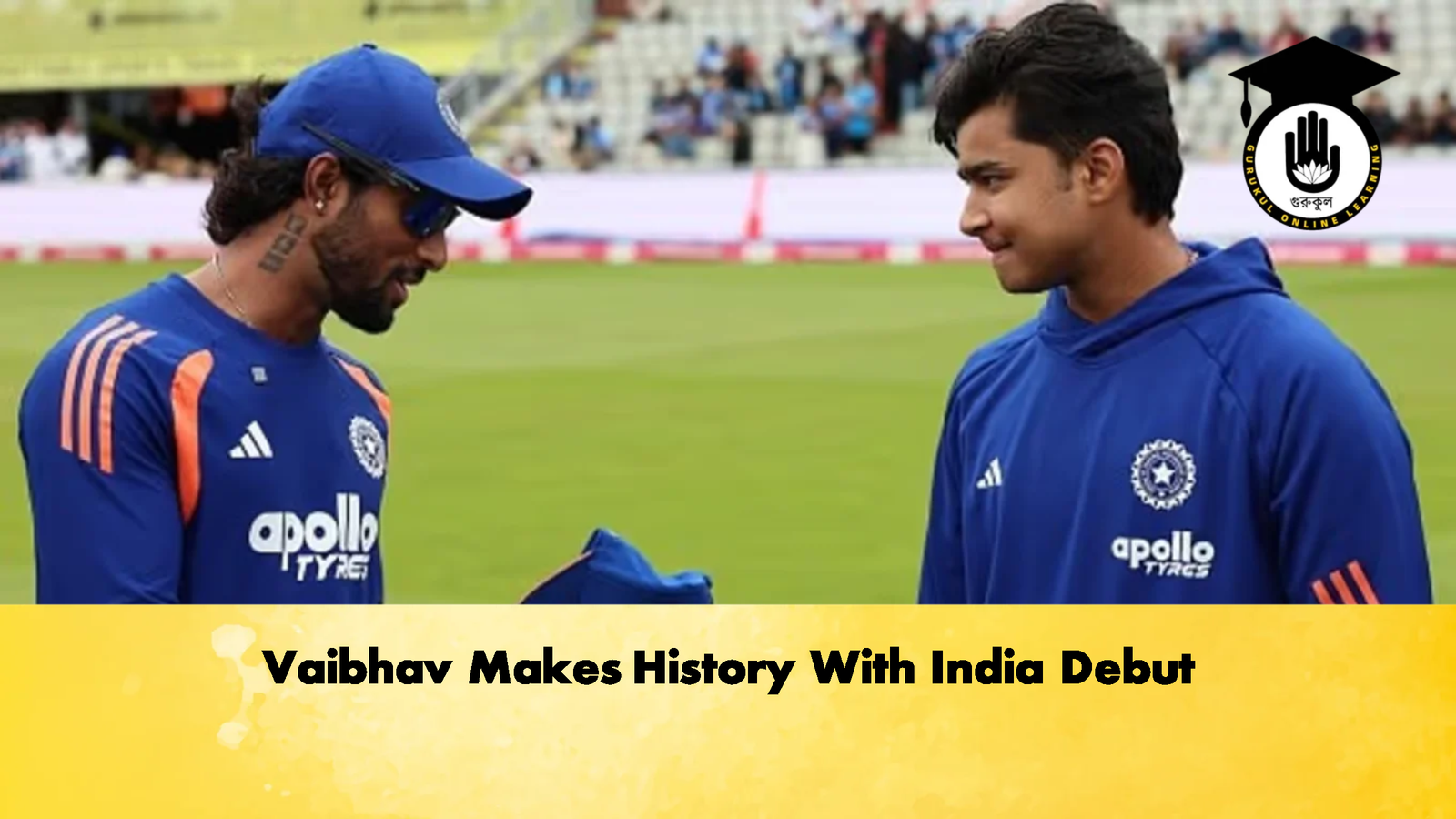
While much of the sporting world has been captivated by the FIFA World Cup, another teenage sensation has quietly emerged as one of international sport’s most compelling stories. India’s 15-year-old batting prodigy, Vaibhav Suryavanshi, finally made his long-awaited international debut after weeks of intense public anticipation, becoming the youngest player ever to represent India in international cricket.
His selection has been one of the most closely followed narratives in Indian cricket this year. Suryavanshi announced himself as an extraordinary talent during a breathtaking Indian Premier League (IPL) campaign, where his fearless stroke play and remarkable consistency transformed him into one of the tournament’s biggest attractions. His performances convinced many that his elevation to the senior national side was inevitable.
Yet, despite the overwhelming public demand, Suryavanshi remained on the sidelines for India’s two Twenty20 Internationals against Ireland and the opening match of the England series. His absence sparked widespread debate across television studios, social media and among former international cricketers, many of whom questioned why a player in such exceptional form had not been handed an opportunity.
For those who had witnessed his exploits in the IPL, the excitement surrounding the teenager was far from exaggerated. He had dismantled some of the world’s finest bowlers with astonishing composure, displaying a level of confidence rarely associated with someone so young.
The wait finally ended on Saturday at Old Trafford in Manchester.
Suryavanshi was named in India’s starting XI for the second T20 International against England, becoming the youngest cricketer to make an international appearance for India at just 15 years and 99 days. In doing so, he eclipsed one of the country’s most celebrated milestones, surpassing Sachin Tendulkar, who was 16 years and 205 days old when he made his international debut in 1989.
India vice-captain Tilak Varma presented the youngster with his maiden international cap, marking a symbolic moment that many believe could herald the beginning of another remarkable chapter in Indian cricket.
A Difficult Selection Decision
Despite the public clamour, India’s team management faced a genuine selection dilemma.
The national side boasts one of the strongest batting line-ups in world cricket, particularly in the shortest format. Abhishek Sharma has established himself among the game’s most destructive T20 openers, while Ishan Kishan has consistently delivered at the top of the order. Sanju Samson, another experienced opener, was instrumental in India’s recent T20 World Cup triumph, scoring 321 runs in five innings at an outstanding average of 80.25 and an exceptional strike rate of 199.37.
Removing any member of such an accomplished batting unit inevitably carried significant risk.
Head coach Gautam Gambhir and captain Shreyas Iyer eventually decided to introduce Suryavanshi after Samson endured a disappointing run of scores, managing only 5, 0 and 1 in his previous three innings. The decision created the opening the teenager had been waiting for.
The delay in his selection had increasingly drawn criticism. Assistant coach Ryan ten Doeschate defended the management’s cautious approach by insisting that Suryavanshi, like every other player, needed to “go through the process” before earning an international opportunity.
Those remarks did little to calm the debate. Many observers argued that players with exceptional ability should not be held back by convention when their performances clearly justify selection.
Captain Backs Teenage Sensation
Repeated questions surrounding Suryavanshi’s omission eventually fell to captain Shreyas Iyer, who spoke enthusiastically about the youngster before the second T20I.
Iyer insisted that the teenager had fully earned his opportunity through sustained performances and praised his maturity, temperament and fearless approach despite his age.
According to the India captain, Suryavanshi trains with remarkable confidence and never appears overawed, even when facing some of the country’s most accomplished bowlers. Iyer also highlighted the extraordinary depth of Indian cricket, suggesting that fierce competition for places ultimately strengthens the national team by ensuring standards remain exceptionally high.
His comments reflected the confidence within the Indian dressing room that Suryavanshi possesses not only immense natural talent but also the mental resilience required to succeed at the highest level.
Numbers That Justify the Hype
The remarkable attention surrounding Suryavanshi is firmly supported by an extraordinary body of performances across domestic and age-group cricket.
During the latest IPL season, the teenage opener amassed an astonishing 776 runs at a strike rate of 237.30, smashing 72 sixes while dominating some of the world’s leading international bowlers.
His spectacular campaign earned him a remarkable collection of honours, including the Most Valuable Player award, the Orange Cap, Emerging Player, Super Striker and Super Sixes awards. At only 15 years of age, he also surpassed Chris Gayle’s record for the most sixes struck by a player of the same age during the competition.
His rich vein of form continued immediately afterwards.
Representing India A in a tri-nation tournament in Sri Lanka, Suryavanshi scored 211 runs in five innings, including a blistering 94 in the final. During the tournament, he also produced a record-breaking half-century from just 11 deliveries against Sri Lanka A, setting a new benchmark for the fastest fifty in List A cricket.
His performances across all formats underline why selectors and supporters alike view him as a complete batter rather than merely a T20 specialist.
| Competition/Format | Performance |
|---|---|
| IPL 2026 | 776 runs |
| IPL Strike Rate | 237.30 |
| IPL Sixes | 72 |
| IPL Awards | Most Valuable Player |
| IPL Awards | Orange Cap |
| IPL Awards | Emerging Player |
| IPL Awards | Super Striker |
| IPL Awards | Super Sixes |
| India A Tri-series | 211 runs in five innings |
| India A Tri-series Final | 94 runs |
| Fastest List A Fifty | 11 balls |
| First-class Cricket | 207 runs in 12 innings (eight matches) |
| Youth Tests | 331 runs in 10 innings |
| List A Cricket | 564 runs in 13 matches |
| Highest List A Score | 190 |
| Youth One-Day Internationals | 1,412 runs in 25 matches |
| Youth ODI Average | 56.48 |
| Youth ODI Strike Rate | 165.72 |
| ICC Under-19 World Cup | 439 runs in seven matches (leading run-scorer) |
Such statistics explain why many respected cricket observers believe Suryavanshi has both the technical quality and the temperament to flourish across all three international formats.
A Historic Beginning
The teenager’s first innings for India did not entirely match the extraordinary expectations that surrounded his debut.
He scored 14 runs from just 10 deliveries, striking two towering sixes before being dismissed. Yet few judged the innings solely by the numbers.
The significance of the occasion extended well beyond a brief cameo. At Old Trafford—the ground where Sachin Tendulkar scored the first Test century of his legendary career—another gifted Indian teenager began his own international journey by breaking one of Tendulkar’s earliest records.
Comparisons with the Indian icon are inevitable, though they also illustrate the scale of the challenge that lies ahead. Tendulkar’s extraordinary international career spanned 24 years and yielded 664 matches, 34,357 runs and an unmatched 100 international centuries, achievements that continue to define cricketing greatness.
For Suryavanshi, this debut is not the fulfilment of a promise but the first step in what supporters hope will become a distinguished international career. His meteoric rise has already demonstrated that exceptional talent cannot be overlooked indefinitely.
The far greater challenge now begins. Sustaining excellence over years rather than months will determine whether India’s newest teenage sensation can convert immense promise into lasting greatness. With the cricketing world watching closely, Suryavanshi has taken the first step on a journey that could shape the future of Indian cricket for years to come.