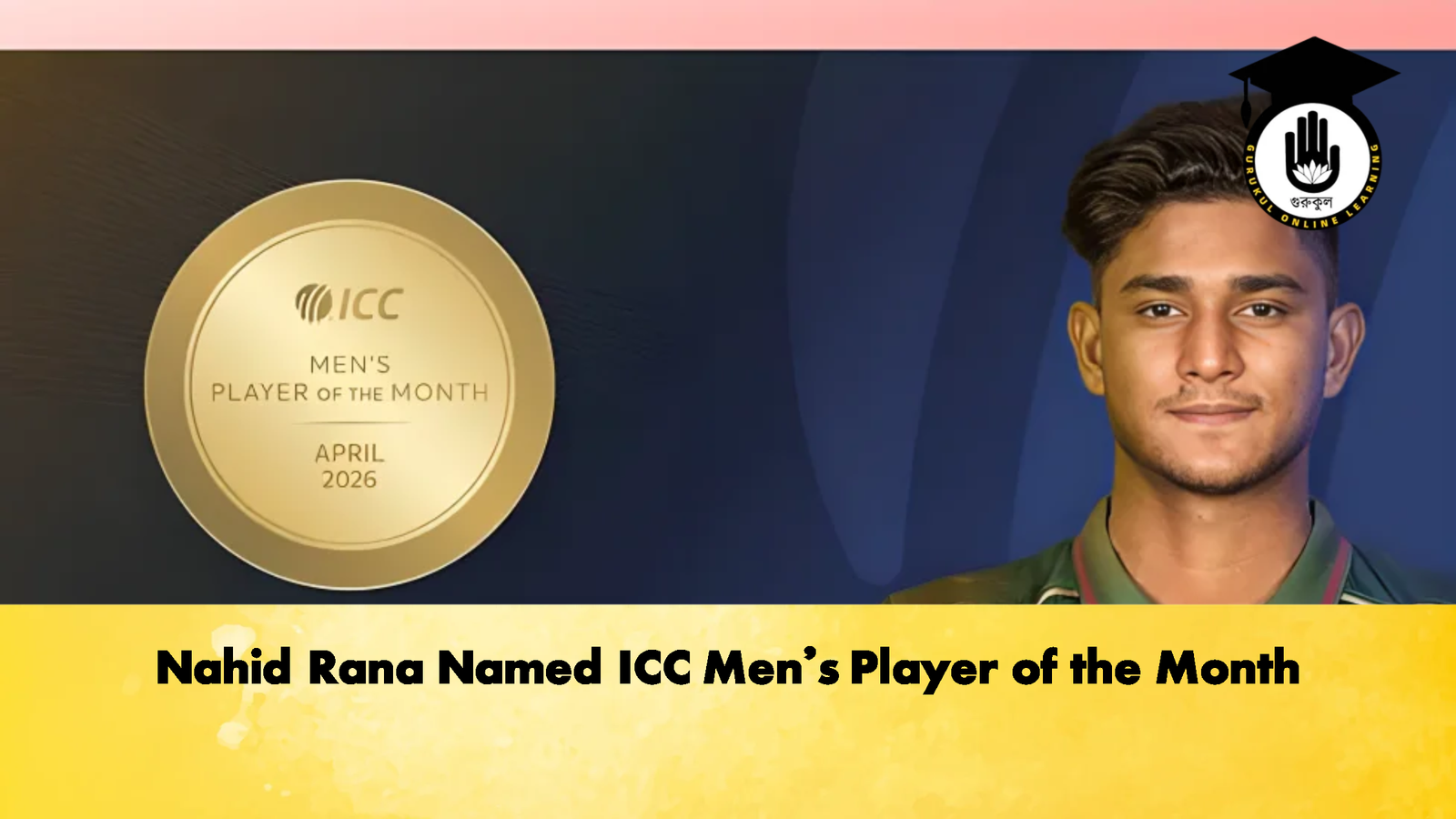
The International Cricket Council (ICC) has formally announced that the Bangladeshi fast bowler, Nahid Rana, has been awarded the Men’s Player of the Month title for April 2026. This prestigious accolade follows a period of sustained excellence for the young paceman, whose high-velocity contributions were pivotal in Bangladesh’s recent home series triumph against New Zealand.
The official confirmation was delivered via a press statement from the sport’s global governing body on Thursday, 14 May 2026. Rana emerged as the victor after a competitive voting process, surpassing fellow nominees Jatinder Singh of Oman and Ajay Kumar of the United Arab Emirates. This recognition marks the first time Rana has secured the monthly international honour and underscores the current ascendancy of the Bangladeshi pace attack within the global cricketing landscape.
Statistical Dominance in the New Zealand Series
Nahid Rana’s selection is primarily predicated on his clinical performance during the three-match One Day International (ODI) series against New Zealand. Over the course of the three fixtures, the fast bowler accounted for eight wickets, maintaining a consistent threat that stifled the visiting batting order.
His statistical profile for the series reflects a high degree of efficiency:
Total Wickets: 8
Bowling Average: 16.75
Economy Rate: 4.46 runs per over
This sequence of performances continues a significant trend for the bowler; in March 2026, Rana also secured eight wickets during an ODI series against Pakistan. By achieving this ICC recognition, Rana becomes the first Bangladeshi male cricketer to be named Player of the Month since the all-rounder Mehidy Hasan Miraz received the award in April 2025.
Detailed Match-by-Match Analysis
The trajectory of Rana’s performance during the month was defined by tactical resilience. The series did not begin optimally for the paceman; in the opening ODI, he struggled to find his rhythm, conceding 65 runs while claiming only a single wicket. However, the subsequent fixtures saw a disciplined recovery.
The Second ODI: A Career-Defining Spell
During the second ODI, staged at the Sher-e-Bangla National Cricket Stadium in Mirpur, Rana produced what many analysts consider his finest international performance to date. Utilising the early morning conditions, he dismantled the New Zealand top order during the powerplay, claiming two dismissals in his opening spell. He maintained this pressure throughout the middle overs, eventually taking three further wickets to finish with figures of 5/32. This performance was instrumental in restricting the opposition to a total of 198 runs and marked the second five-wicket haul of his professional career, following his inaugural “fifer” against Pakistan in March.
The Third ODI: Securing the Series
In the series decider held in Chittagong, Rana maintained his disciplined approach. In a high-stakes environment, he claimed two vital wickets, ensuring that Bangladesh secured a 2–1 series victory. His consistency across the three matches resulted in him being named the Player of the Series, an honour that served as a precursor to his global recognition by the ICC.
Historical Context and Regional Impact
The ascent of Nahid Rana signifies a notable shift in the composition of the Bangladeshi national side, which has traditionally relied upon spin-heavy strategies. Rana’s ability to maintain speeds in excess of 145 kilometres per hour, combined with his tactical maturity, has provided the “Tigers” with a potent spearhead in their fast-bowling department.
The ICC Player of the Month awards are determined by an independent voting academy comprising former cricketers, broadcasters, and journalists, alongside a public vote. Rana’s victory over Singh and Kumar—both of whom had performed admirably for their respective Associate nations during the period—highlights the significant weight given to his performances against a top-tier cricketing nation like New Zealand.
This award marks a significant milestone for Rana, who has rapidly established himself as a central figure in the Bangladeshi squad. His back-to-back performances against Pakistan and New Zealand within a two-month window indicate a sustained period of form that has now been validated by the sport’s highest governing authority.