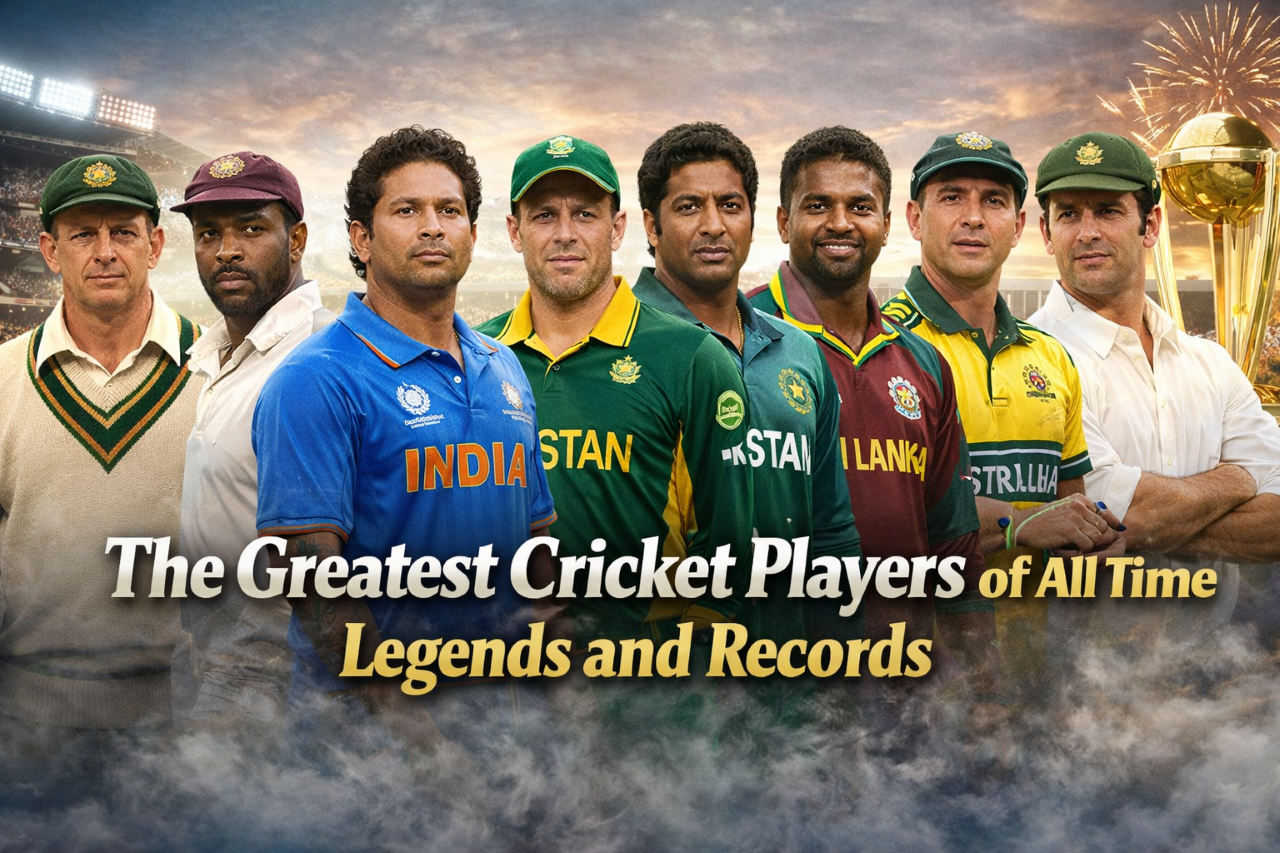
Cricket is more than a sport. For over three centuries it has been a cultural force, a political symbol, and a source of identity for millions across continents. From dusty village grounds in the Caribbean to packed stadiums in India, from England’s green county pitches to Australia’s blazing outfields, cricket has created heroes whose names have transcended sport itself.
What makes a player “the greatest of all time”? Is it raw statistics? Longevity? Influence? The ability to dominate under pressure? Or the power to change how the game is played?
The answer is: all of these.
This article explores the greatest cricketers of all time, not just by numbers, but by legacy. These are the players who redefined batting, revolutionized bowling, inspired generations, and left records that still shape the modern game.
1: Sir Don Bradman – The Unreachable Benchmark
In the long and storied history of cricket, no name stands taller than Sir Donald George Bradman. His achievements are not merely records; they are mathematical impossibilities, psychological mysteries, and cultural landmarks. More than ninety years after he first stunned the cricketing world, Bradman remains the ultimate standard by which all batsmen are judged. No player before him, and none since, has come close to matching the extraordinary heights he reached.
Bradman is not simply the greatest cricketer of all time—he is one of the greatest sportsmen in the history of any game.
A Childhood Forged in Imagination and Discipline
Don Bradman was born on 27 August 1908 in the small Australian town of Cootamundra, New South Wales. His family soon moved to Bowral, where young Don spent countless hours practicing alone. Lacking proper equipment, he created his own training system: throwing a golf ball against a corrugated water tank and hitting it back with a cricket stump.
This unusual practice sharpened his reflexes to superhuman levels. The ball rebounded at unpredictable angles and speeds, forcing Bradman to react instantly. What looked like a childhood game was, in fact, the perfect training ground for the fastest bowling he would later face.
From an early age, Bradman was different. By his teenage years, he was scoring hundreds against adult opponents. His talent was not loud or flashy—it was precise, quiet, and devastating.
The Rise of a Phenomenon
Bradman made his Test debut in 1928 against England. Though he failed in his first innings, he announced himself in the second with a brilliant century. It was only the beginning.
In the 1930 Ashes series in England, Bradman stunned the world by scoring 974 runs in just seven innings, including:
- 254 at Lord’s
- 334 at Headingley
- 232 at The Oval
No one had ever dominated a series like this. England’s bowlers were helpless. Crowds flocked to watch not just a batsman, but a once-in-a-century miracle.
By the age of 22, Bradman had already rewritten cricket’s history.
The Statistical Miracle
Bradman’s career Test average of 99.94 is the most famous statistic in sports. To understand how impossible this is:
- The second-highest Test average (among long careers) is in the low 60s.
- Modern legends like Sachin Tendulkar, Ricky Ponting, and Jacques Kallis average in the 50s.
- To equal Bradman’s average, a player would need to score four centuries for every single failure.
In his final innings, Bradman needed only four runs to finish with a perfect average of 100. He was bowled for zero.
That moment became symbolic: even perfection was just out of reach—yet he remained peerless.
The Bodyline War: Cricket’s Darkest Chapter
Bradman’s dominance forced England to adopt a controversial strategy in the 1932–33 Ashes: Bodyline bowling.
Fast bowlers aimed short, fast deliveries at Bradman’s body, supported by leg-side fielders. It was dangerous, aggressive, and nearly broke international cricket relations.
Bradman initially struggled, but soon adapted, scoring heavily even against Bodyline. The series became a political and sporting crisis—but it also proved Bradman’s resilience.
The Leader and the Man
Bradman was not just a batsman. He was a captain, administrator, and ambassador for cricket.
He led Australia with discipline and pride, demanding excellence from his teammates. While he could be stern, he was respected for his fairness and integrity.
After retirement, Bradman served as an administrator and advisor, shaping Australian cricket’s future. He was knighted in 1949, becoming Sir Don Bradman, the first cricketer to receive such an honor.
A Global Icon
Bradman’s fame went beyond cricket. In Australia, he became a national symbol—of perseverance during the Great Depression, of unity during wartime, and of excellence in sport.
When he passed away in 2001, tributes came from every corner of the globe. The Australian Prime Minister called him “the greatest Australian who ever lived.”
Why Bradman Can Never Be Surpassed
Cricket has changed. Pitches, bats, fitness, and technology have evolved. Players face more formats, more travel, more pressure.
Yet Bradman’s numbers still stand far beyond reach. No modern system can replicate the isolation, pressure, and consistency he mastered.
He was not just ahead of his time—he was outside of time.
Legacy
Don Bradman is not remembered only through numbers. He is remembered through awe.
Every young cricketer, knowingly or unknowingly, chases his shadow. But Bradman remains alone at the summit—the unreachable benchmark.
“I’m not a hero. I’m just a man who was lucky enough to do something he loved.”
— Sir Don Bradman
2: Sir Vivian Richards – The King of Fearless Batting
In the history of cricket, there have been many great batsmen—some elegant, some consistent, some technically flawless. But only a few have truly terrified bowlers. Among them, one name echoes louder than all others: Sir Vivian Richards.
Richards did not just play cricket—he dominated it. He walked to the crease without a helmet, without fear, and without apology. In an era of hostile fast bowlers and ruthless competition, he redefined what it meant to bat with power, pride, and purpose. He was not just a great batsman; he was a force of nature.
A Warrior from Antigua
Sir Isaac Vivian Alexander Richards was born on 7 March 1952 in Antigua, a small island in the Caribbean. Cricket in the West Indies was not just a sport—it was identity, resistance, and pride.
Growing up in a region shaped by colonial history, Richards and his teammates carried more than bats—they carried the spirit of a people. His style reflected that spirit: bold, aggressive, and uncompromising.
He learned cricket on dusty grounds, playing fearlessly against older boys. Even as a teenager, he was known for his confidence and explosive shot-making.
The Arrival of a Legend
Viv Richards made his Test debut in 1974 against India. What followed shocked the cricketing world.
In just his second Test, he scored a breathtaking 192, announcing the arrival of a new kind of batsman—one who attacked from the first ball. His bat seemed to command the field.
He followed this with 114 at Port of Spain* and soon established himself as the backbone of the greatest team cricket has ever seen—the West Indies of the 1970s and 80s.
Fearless in the Age of Fast Bowling
Richards played in the most brutal era of fast bowling:
- Dennis Lillee
- Jeff Thomson
- Imran Khan
- Malcolm Marshall
- Michael Holding
- Joel Garner
These men bowled at express pace, often aiming for the body. Helmets were rare. Yet Richards never flinched. He stood tall, chest out, eyes burning, daring bowlers to challenge him.
He famously said:
“I never walked to the crease expecting to survive. I walked to dominate.”
His bat was his weapon, and the bowlers knew it.
A Revolutionary Batting Style
Richards changed batting forever. Before him, attacking cricket was risky. After him, it became a philosophy.
His trademarks:
- Flat bat punches through covers
- Towering pulls and hooks
- Fearless drives against pace
- Total authority over bowlers
He did not wait for bad balls. He created scoring opportunities.
Records That Defined Greatness
- Test Runs: 8,540
- Test Average: 50.23
- ODI Runs: 6,721
- Strike Rate (ODIs): 90.20 (unheard of in his era)
- Fastest Test century (56 balls)
- First player to score 1000 ODI runs in a calendar year
- ICC Cricketer of the Century (shared with Bradman)
His strike rate was decades ahead of his time. In today’s cricket, he would be a T20 superstar—but he achieved it in white clothes, on difficult pitches, against terrifying bowlers.
The Heart of a Champion Team
Richards was the soul of the legendary West Indies team that ruled world cricket for over 15 years.
As captain, he led with fire and belief. His teams were fearless, united, and unstoppable.
Under his leadership, West Indies:
- Remained undefeated in Test series for 15 years
- Won the 1987 World Cup Final
- Ruled world cricket with unmatched dominance
More Than a Cricketer
Viv Richards represented pride for the Caribbean people. He showed that confidence, culture, and strength could walk together.
He wore jewelry on the field, strutted to the crease, and looked bowlers in the eye. He played for freedom, not fear.
He was knighted in 1999, becoming Sir Vivian Richards.
Why He Is Still the King
Modern cricket is full of power hitters. But no one carries the presence, aura, and authority that Richards did.
He didn’t just score runs.
He made bowlers doubt themselves.
He is not just remembered—he is felt.
Legacy
Sir Vivian Richards taught the world one powerful lesson:
Cricket is not about survival. It is about domination.
He remains the ultimate symbol of fearless batting.
3: Sachin Tendulkar – The God of Cricket
In the vast history of world sport, only a few athletes rise beyond records and statistics to become symbols of a nation. In cricket, that name is Sachin Ramesh Tendulkar. To millions, he is not just a player—he is emotion, inspiration, and faith. They call him “The God of Cricket,” not because he asked for the title, but because the world gave it to him.
For over twenty-four years, Sachin carried the hopes of a billion people every time he walked to the crease. In stadiums across the globe, crowds rose when he arrived. Television ratings soared. Time seemed to pause. Cricket itself felt sacred in his presence.
A Prodigy from Mumbai
Sachin was born on 24 April 1973 in Mumbai, India. His elder brother Ajit recognized his talent and took him to coach Ramakant Achrekar, a legendary mentor who would shape the future icon.
At just 11 years old, Sachin joined Achrekar’s nets. He trained relentlessly—sometimes for 6–7 hours a day. His dedication was so intense that Achrekar would place a coin on the stumps: if Sachin got out, he lost the coin. If he stayed not out, he kept it. That coin became his first trophy and his lifelong motivation.
The Youngest Star
At 16 years old, Sachin made his Test debut against Pakistan in 1989—facing the world’s most feared fast bowlers: Wasim Akram, Waqar Younis, and Imran Khan.
In one match, he was struck on the nose by Waqar Younis, bleeding heavily. Instead of leaving, he returned to bat and scored 57 runs—showing the courage of a warrior.
The world knew: a legend was born.
Master of All Formats
Sachin adapted to every era, every format, and every challenge.
Test Cricket
- 15,921 runs
- 51 centuries
- Average: 53.78
One-Day Internationals
- 18,426 runs
- 49 centuries
- First player to score a double century in ODIs
- 100 international centuries (unmatched)
His records remain monuments in cricket history.
The Art of Perfection
Sachin’s batting was a blend of:
- Classical technique
- Modern innovation
- Unmatched balance
- Lightning-fast reflexes
Every stroke—from the straight drive to the upper cut—looked like poetry in motion.
Great bowlers like Shane Warne, Glenn McGrath, Wasim Akram, Muttiah Muralitharan, and James Anderson all acknowledged him as their toughest opponent.
Carrying a Nation
For two decades, when India struggled, they turned to Sachin.
When he scored, the nation celebrated.
When he failed, the nation mourned.
His success united millions across caste, religion, and class. Cricket became religion, and Sachin its priest.
The 2011 World Cup Dream
After six World Cup appearances, Sachin finally lifted the trophy in 2011.
His teammates carried him on their shoulders and said:
“He has carried us for 21 years. Now we carry him.”
It was the perfect ending.
Honors Beyond Cricket
- Bharat Ratna (India’s highest civilian award)
- Padma Vibhushan, Padma Shri
- Rajya Sabha Member
- ICC Cricketer of the Year
- Wisden Cricketer of the Year
A Gentle Hero
Despite global fame, Sachin remained humble. He avoided controversy, respected opponents, and always credited his team.
He showed that greatness and humility can walk together.
Why He Is the God of Cricket
Because he:
- Ruled all formats
- Inspired generations
- United a nation
- Set impossible records
- Played with grace and heart
Sachin Tendulkar is not just remembered—he is worshipped.
4: Jacques Kallis – The Greatest All-Rounder Ever?
In the rich and often romantic history of cricket, very few players have mastered both arts of the game—batting and bowling—at the highest level for a sustained period. Even fewer have done so with the level of consistency, elegance, and impact achieved by Jacques Henry Kallis of South Africa.
While names like Sir Garfield Sobers, Kapil Dev, Imran Khan, Ian Botham, and Richard Hadlee often dominate debates about the greatest all-rounder, a new benchmark emerged in the modern era. That benchmark was Jacques Kallis—a man whose numbers alone make the argument, and whose quiet excellence changed how all-round greatness is measured.
A Cape Town Prodigy
Born on October 16, 1975, in Cape Town, South Africa, Kallis grew up in a cricket-loving environment. His father was a club cricketer, and from a young age, Jacques displayed a rare balance between batting skill and bowling control.
He made his Test debut in 1995 at just 19, and his ODI debut in 1996. At first, he was seen primarily as a batsman who could bowl a bit. Over time, he evolved into something far greater—a genuine match-winner with both bat and ball.
The Numbers That Redefined Greatness
Test Cricket
- 13,289 runs
- 45 centuries
- 292 wickets
- Batting average: 55.37
- Bowling average: 32.65
One-Day Internationals
- 11,579 runs
- 17 centuries
- 273 wickets
All Formats Combined
- Over 25,000 international runs
- Over 570 international wickets
- More than 300 international catches
No other player in cricket history has reached these combined heights.
The Silent Warrior
Unlike flamboyant stars, Kallis was quiet, composed, and clinical. He didn’t seek the spotlight. He simply delivered—again and again.
He could:
- Anchor a collapsing innings
- Accelerate when required
- Bowl long, disciplined spells
- Break partnerships
- Field safely in the slips
He was the definition of reliability.
A Rock for South Africa
For nearly two decades, Kallis was the pillar of South Africa’s batting. Whether opening, playing at No. 3, or stabilizing the middle order, he adapted to every role.
In pressure situations, teammates looked to him for calm. When wickets fell quickly, Kallis remained unshaken.
The Perfect Technique
His batting was classical—textbook straight drives, strong off-side play, and immense patience. His bowling, though not express pace, was accurate, clever, and deadly in helpful conditions.
He didn’t rely on aggression. He relied on precision.
Big-Match Performer
Kallis delivered on the world stage:
- Match-winning knocks against Australia, England, India, and Pakistan
- Crucial performances in World Cups
- Hundreds in difficult conditions—Australia, England, the West Indies
He was a giant-killer who feared no attack.
Comparing the Legends
| Player | Runs | Wickets | Test Avg (Bat) | Test Avg (Bowl) |
|---|---|---|---|---|
| Kallis | 13,289 | 292 | 55.37 | 32.65 |
| Sobers | 8,032 | 235 | 57.78 | 34.03 |
| Imran | 3,807 | 362 | 37.69 | 22.81 |
| Kapil | 5,248 | 434 | 31.05 | 29.64 |
| Botham | 5,200 | 383 | 33.54 | 28.40 |
Kallis stands apart for balance and longevity.
A Champion’s Legacy
Kallis retired in 2014, leaving behind a legacy unmatched in the modern era. He proved that true greatness is not always loud—it is consistent, enduring, and undeniable.
Why He May Be the Greatest
Because he:
Excelled in all conditions
Dominated for nearly 20 years
Delivered with bat, ball, and in the field
Set a new standard for all-rounders
Jacques Kallis was not just an all-rounder. He was the gold standard.
5: Wasim Akram – The Sultan of Swing
When the history of fast bowling is written in bold letters, Wasim Akram stands near the very top. He was not merely fast—he was artistic. Not just lethal—but revolutionary. In an era filled with intimidating quicks, Wasim Akram changed the very language of fast bowling. He did not rely solely on pace or aggression; he relied on swing, deception, and intelligence. To millions of cricket fans around the world, he is rightly remembered as “The Sultan of Swing.”
From Raw Talent to Global Superstar
Born on June 3, 1966, in Lahore, Pakistan, Wasim Akram was discovered almost by accident. As a young, skinny left-armer, he had no formal coaching. His action was raw, his pace natural, and his swing mesmerizing. His talent was first spotted during a trial camp, and he was quickly fast-tracked into the national team.
At just 18 years old, Wasim made his international debut. Few expected him to become one of the greatest fast bowlers in cricket history—but the cricketing world would soon witness something extraordinary.
The Art of Reverse Swing
Wasim’s greatest gift was his mastery of reverse swing. While conventional swing moves the ball in the air with the seam, reverse swing makes the ball move late and sharply, even with an old ball. Wasim perfected this craft.
He could:
- Swing the new ball at high speed
- Reverse the old ball at deadly pace
- Bowl toe-crushing yorkers at will
- Outsmart the world’s best batters
Batsmen never knew which way the ball would move—and by the time they reacted, it was already too late.
Record-Breaking Numbers
Test Cricket
- 414 wickets
- 3,717 runs
- Average: 23.62
One-Day Internationals
- 502 wickets (first in history)
- 3,713 runs
All Formats
- 916 international wickets
Wasim remains one of only a handful of bowlers to cross 900 international wickets.
World Cup Hero
Wasim’s defining moment came in the 1992 Cricket World Cup Final. His two magical deliveries to Allan Lamb and Chris Lewis turned the match on its head and sealed Pakistan’s first and only World Cup victory.
It was a moment of genius—one that immortalized him.
A Leader and Mentor
As Pakistan’s captain, Wasim nurtured a new generation of fast bowlers. Legends like Waqar Younis, Shoaib Akhtar, Mohammad Asif, and Mohammad Amir were all influenced by him.
He wasn’t just a bowler—he was a school of fast bowling.
The Fear Factor
Facing Wasim was a nightmare. His left-arm angle, late swing, and clever variations meant even the greatest batters—Viv Richards, Sachin Tendulkar, Brian Lara—struggled against him.
They respected him. They feared him.
Legacy of a Sultan
Wasim Akram retired in 2003, but his influence lives on. He revolutionized swing bowling and inspired countless young fast bowlers around the world.
Today, whenever a ball curves late and smashes into the stumps, fans remember the original master.
Wasim Akram wasn’t just a fast bowler.
He was the Sultan of Swing.
6: Muttiah Muralitharan – The Spin Wizard
In the vast history of cricket, dominated for long periods by fast bowlers and flamboyant batters, one man rewrote the rules of the game with nothing but spin, guile, and relentless accuracy. His name is Muttiah Muralitharan—the highest wicket-taker the sport has ever known. More than records, Murali’s greatness lies in the way he changed the perception of spin bowling forever.
With a uniquely bent arm, a beaming smile, and an unplayable off-spinner, Murali bamboozled the world’s best batters for nearly two decades. He was not just a spinner; he was a phenomenon, earning his rightful title—“The Spin Wizard.”
Humble Beginnings in Sri Lanka
Born on April 17, 1972, in Kandy, Sri Lanka, Murali grew up in modest surroundings. Unlike many modern cricketers, he had no professional facilities or elite academies. What he had was passion and perseverance.
He was introduced to cricket at school and quickly stood out—not for speed or strength, but for his strange, powerful spin. His bowling action was unlike anything seen before, and it drew immediate attention.
The Controversy That Forged a Champion
Murali’s career was repeatedly overshadowed by accusations of illegal bowling. He was “no-balled” on international television, humiliated publicly, and questioned constantly.
But scientific testing proved that his elbow was naturally bent and that his action was legal under ICC rules. Murali responded not with anger—but with performance. Each criticism only sharpened his resolve.
He turned controversy into fuel and emerged stronger.
Unmatched Records
Murali’s numbers are not just great—they are historic.
Test Cricket
- 800 wickets – the highest ever
- 133 matches
- 67 five-wicket hauls
- 22 ten-wicket matches
One-Day Internationals
- 534 wickets
- 350 matches
Total International Wickets
- 1,334 wickets – a world record
No bowler in history comes close to this tally.
Master of Variations
Murali possessed a magical arsenal:
- Off-break
- Doosra
- Top-spinner
- Carrom ball
- Arm ball
Batters never knew what was coming next. His spin was late, sharp, and devastating—even on flat pitches.
The Sri Lankan Warrior
Murali was the backbone of Sri Lanka’s golden era. He played a key role in:
- 1996 World Cup victory
- 2002 Champions Trophy win
- Multiple series wins against Australia, England, and India
He made Sri Lanka a global force.
The Gentleman Wizard
Off the field, Murali was humble, smiling, and kind. He never held grudges—even against those who questioned him. He represented the spirit of cricket.
An Eternal Legacy
Muttiah Muralitharan redefined spin bowling. His records may never be broken. His artistry will never be forgotten.
He was not just a spinner.
He was the Spin Wizard.
7: Sir Garfield Sobers – The Perfect Cricketer
If cricket had to choose one player who embodied every skill the game demands, the name that rises above all others is Sir Garfield St Aubrun Sobers. Batting, bowling, fielding—Sobers mastered them all with a natural elegance that made him look effortless. He wasn’t just great at everything; he was the standard by which greatness itself is measured.
To fans and historians alike, Sobers is known as “The Perfect Cricketer”—a title no one else has ever truly claimed.
From Barbados to the World Stage
Born on July 28, 1936, in Bridgetown, Barbados, Sobers lost his father at a young age. Cricket became his escape and purpose. By his teens, he was already a prodigy, and at just 17 years old, he debuted for the West Indies.
Early on, he was seen as a bowling all-rounder, but his batting soon evolved into something extraordinary.
The Greatest All-Round Skillset
Sobers could:
- Bat with classical grace or explosive power
- Bowl left-arm fast, medium, orthodox spin, and wrist spin
- Field anywhere with athletic brilliance
No cricketer before or since has mastered so many disciplines at the elite level.
Historic Records
Test Cricket
- 8,032 runs
- 26 centuries
- 365 wickets
- 235 catches
He was the first man to score six sixes in an over in first-class cricket.
A Leader of Legends
As West Indies captain, Sobers built a foundation for their domination in the 1970s and 80s. His leadership inspired generations.
The Gentleman of Cricket
Sobers was humble, gracious, and universally respected. He represented cricket’s highest ideals.
Eternal Greatness
There will be great all-rounders, but there will only ever be one Sobers.
He wasn’t just the perfect cricketer—
He was cricket perfected.
8: Ricky Ponting – The Ultimate Winner
When the conversation turns to great captains, big-match players, and ruthless winners, one name stands taller than almost all others—Ricky Thomas Ponting. Fierce, uncompromising, and endlessly driven, Ponting was not just a great cricketer; he was the embodiment of Australia’s winning era.
He played cricket like a general goes to war—to dominate, to conquer, and to leave nothing behind. That is why he is remembered as “The Ultimate Winner.”
From Launceston to World Supremacy
Born on December 19, 1974, in Launceston, Tasmania, Ponting showed elite talent from childhood. He was a sporting prodigy—equally gifted in Australian Rules football—but cricket won his heart.
At just 20 years old, he made his Test debut for Australia. His aggressive stroke play, fierce competitiveness, and sharp cricket brain marked him as a future leader.
The Backbone of Australia’s Golden Age
Ponting was the central pillar of Australia’s most dominant era (1999–2007). Playing alongside legends like Shane Warne, Glenn McGrath, Adam Gilchrist, and Matthew Hayden, Ponting was the glue that held this dynasty together.
While others were great, Ponting made them unstoppable.
Batting: Power with Precision
Ponting’s batting combined:
- Classical technique
- Brutal pull and hook shots
- Razor-sharp placement
- Supreme confidence under pressure
He was devastating against pace and fearless against spin. When Ponting walked in, opposition teams felt the match slipping away.
Career Records
Test Cricket
- 13,378 runs
- 41 centuries
- 51 fifties
- Average: 51.85
One Day Internationals
- 13,704 runs
- 30 centuries
- Average: 42.03
He remains one of only a few players to score over 13,000 runs in both Tests and ODIs.
Captain of Champions
Ponting captained Australia in:
- 2 ICC World Cup wins (2003, 2007)
- 1 Champions Trophy
- 2 Ashes whitewashes
Under him, Australia became nearly unbeatable. His teams played relentless, intelligent, and fearless cricket.
Big-Match Mentality
Ponting’s best came in finals and pressure games:
- 140 in the 2003 World Cup Final*
- Back-to-back Ashes centuries
- Countless match-winning innings
When the stage was biggest, Ponting was at his best.
A Master Strategist
Ponting read the game brilliantly. His field placements, bowling changes, and match awareness were elite. He demanded excellence—and inspired it.
Legacy of a Winner
Ricky Ponting did not chase records—he chased victory. His hunger, intensity, and leadership defined a generation.
He didn’t just play to win—
He was built to win.
9: Imran Khan – The Revolutionary Leader
Imran Khan is not just one of the greatest cricketers of all time—he is one of the most transformational figures the game has ever known. To Pakistan, he is far more than a sports hero; he is a symbol of belief, resilience, and national pride. Where others played cricket to succeed, Imran Khan played to change the destiny of a team and a nation. That is why he is remembered as “The Revolutionary Leader.”
A Prince with a Fighter’s Heart
Born on November 25, 1952, in Lahore, into an elite Pashtun family, Imran Khan had all the privileges of a comfortable life. Educated at Aitchison College and later at Oxford University, he was polished, articulate, and charismatic. But beneath the refined exterior was a fierce competitor who hated losing more than anything.
When he debuted for Pakistan in 1971, he was raw and inconsistent—but he was also hungry, fearless, and determined to become the best fast-bowling all-rounder in the world.
From Raw Talent to World-Class Legend
Imran’s early years were difficult. He struggled with injuries, fitness, and form. But he transformed himself through discipline and modern training methods—something almost unheard of in Pakistan cricket at the time.
By the late 1970s and early 1980s, Imran had evolved into one of the world’s most dangerous cricketers:
A fast bowler with devastating swing and seam
A powerful middle-order batsman
A tireless athlete and motivator
He didn’t just improve himself—he dragged Pakistan cricket into the modern age.
Statistics of a Giant
Test Cricket
- 3,807 runs
- 362 wickets
- Average (batting): 37.69
- Average (bowling): 22.81
- 6 centuries, 23 five-wicket hauls
One Day Internationals
- 3,709 runs
- 182 wickets
Imran remains one of the rare players to score 3,000+ runs and take 300+ wickets in Tests.
The Captain Who Changed Everything
Imran Khan became captain in 1982. What followed was nothing short of a revolution.
He introduced:
- Fitness standards
- Merit-based selection
- Fast-bowling culture
- A fearless, aggressive mindset
He believed Pakistan could beat anyone—and slowly, his team began to believe it too.
1992 World Cup – The Ultimate Fairytale
After announcing his retirement in 1991, Imran returned for one last mission: to win Pakistan its first World Cup.
Pakistan started the 1992 tournament terribly—nearly eliminated. But Imran gave his team a speech that changed everything. He called them “cornered tigers.”
They roared back.
Pakistan defeated:
- Australia
- New Zealand
- England in the final
At 39 years old, Imran lifted the World Cup as captain—a story straight out of legend.
Beyond Cricket: A National Icon
Imran’s leadership extended far beyond cricket. His discipline, courage, and vision later took him into philanthropy and politics, where he continued to inspire millions.
He showed the world that:
One leader can change the destiny of many.
Why He Is “The Revolutionary Leader”
Imran Khan did not just win matches—he transformed a system. He created a culture of belief, professionalism, and excellence.
He didn’t follow tradition.
He rewrote it.
10: Modern Icons – Kohli, AB de Villiers, and Dhoni
The modern era of cricket has produced superstars who did far more than score runs or win matches—they redefined how the game is played, watched, and celebrated across the world. Among them, three names stand above the rest: Virat Kohli, AB de Villiers, and MS Dhoni.
Each represents a different ideal of greatness:
- Kohli embodies relentless passion and consistency,
- AB de Villiers represents limitless innovation,
- Dhoni symbolizes calm leadership and strategic genius.
Together, they form the holy trinity of modern cricket.
Virat Kohli – The Relentless Run Machine
Virat Kohli is the most dominant batsman of the 21st century. From his fiery debut in 2008 to becoming India’s most influential captain, Kohli has combined aggression, fitness, and mental toughness to create a new standard for excellence.
The Rise of a Champion
Born in Delhi in 1988, Kohli’s hunger was visible from childhood. He captained India to victory in the 2008 Under-19 World Cup, and soon became a permanent member of the national team. His defining quality? An obsessive desire to be the best.
Records and Impact
Kohli’s ability to score across all formats is unmatched:
- Over 26,000 international runs
- 80+ international centuries
- Fastest to multiple run milestones in ODIs
- One of the greatest chasers in history
He thrives under pressure, especially while chasing targets—turning impossible situations into routine victories.
Cultural Influence
Kohli transformed Indian cricket’s mindset. He emphasized:
- Elite fitness
- Aggressive mentality
- Self-belief
He didn’t just lead—he inspired a generation to dream bigger.
AB de Villiers – The 360-Degree Genius
AB de Villiers is the most creative batsman cricket has ever seen. Nicknamed “Mr. 360”, he could hit any ball to any part of the ground—often inventing shots that no one had seen before.
A Once-in-a-Lifetime Talent
From South Africa, AB was not only a world-class batsman but also a brilliant fielder and occasional wicketkeeper. His reflexes, balance, and imagination made him a phenomenon.
The Art of the Impossible
Some of his astonishing records:
- Fastest ODI 50, 100, and 150
- Strike rate above 135 in ODIs
- Countless match-winning knocks
AB could destroy bowlers while making it look effortless. He played cricket like a magician performs illusions.
MS Dhoni – The Coolest Captain Ever
MS Dhoni is the greatest finisher and leader cricket has ever known. Calm, calculated, and fearless, he led India to the top of the cricketing world.
From Small-Town Dreamer to Global Icon
Born in Ranchi, Dhoni’s journey was one of perseverance. His powerful batting and lightning-fast wicketkeeping earned him a place in the Indian team—and soon, the captaincy.
The Master of Pressure
Dhoni’s finishing skills were legendary:
- Last-over heroics
- Ice-cold temperament
- Match-winning sixes
The Greatest Captain in Indian History
Under Dhoni, India won:
- 2007 T20 World Cup
- 2011 ODI World Cup
- 2013 Champions Trophy
He built a team that trusted itself—and him.
A New Golden Era
Kohli, AB, and Dhoni did more than win matches—they shaped modern cricket. Their influence spans continents, formats, and generations.
They are not just players.
They are legends of the modern age.
What Makes a Legend?
Records fade. Statistics change. But influence lasts forever.
These players were not just athletes—they were architects of cricket’s evolution. They showed the world how a game can inspire, unite, and endure.
Cricket’s greatest legends are not defined only by runs or wickets—but by the memories they created and the generations they inspired.
Statistics:
Legacy & Impact Comparison
| Player | Era | Playing Style | Cultural Impact | Why They Are Unique |
| Bradman | 1930s–40s | Classical dominance | Made cricket global | Avg 99.94 |
| Viv Richards | 70s–80s | Fearless power | Changed batting attitude | No helmet, no fear |
| Sachin Tendulkar | 90s–2010s | Technical perfection | Billion-fan icon | 100 centuries |
| Jacques Kallis | 90s–2010s | All-round excellence | Prototype all-rounder | 10k runs + 250 wkts |
| Wasim Akram | 80s–90s | Swing master | Revolutionized fast bowling | Reverse swing king |
| Muralitharan | 90s–2010s | Mystery spin | Redefined spin | 800 Test wickets |
| Sobers | 60s–70s | Total cricketer | Versatility standard | Bat, bowl, field |
| Ponting | 2000s | Ruthless winner | Team culture builder | 3 WC titles |
| Imran Khan | 80s–90s | Leader all-rounder | National hero | World Cup captain |
| Kohli | 2010s– | Aggressive machine | Fitness revolution | Best chaser |
| AB de Villiers | 2010s | 360° innovator | Entertainment icon | Shot inventor |
| MS Dhoni | 2000s–2010s | Calm finisher | Leadership model | 3 ICC trophies |
“Clutch Factor” Table – Who Performs Under Pressure
| Player | Best Trait | Famous Clutch Moment | Pressure Rating (1–10) |
| Kohli | Chase master | 82* vs Pak (2022) | 10 |
| Dhoni | Finisher | 2011 WC final six | 10 |
| Ponting | Big-match beast | 140* WC Final | 9 |
| Richards | Fear factor | 189* vs Eng | 9 |
| Tendulkar | Crisis savior | 98 vs Pak (2003) | 9 |
| AB | Impossible chases | 149 vs WI | 9 |
Style Comparison – How They Played
| Player | Batting Style | Bowling Style | Leadership Style | Mentality |
| Bradman | Classical | N/A | Silent | Obsessed |
| Richards | Brutal | Medium | Dominant | Fearless |
| Tendulkar | Technical | Medium | Quiet | Disciplined |
| Kohli | Aggressive | Medium | Intense | Relentless |
| AB | Creative | Medium | Supportive | Free-spirited |
| Dhoni | Calculated | N/A | Calm | Ice-cold |
| Imran | All-round | Fast | Inspirational | Warrior |
| Sobers | Elegant | All styles | Natural | Genius |
“If They Played Today” Table
| Player | Likely Modern Role | IPL Value | T20 Suitability |
| Bradman | Anchor + striker | ₹25 Cr | Medium |
| Richards | Power hitter | ₹20 Cr | High |
| Tendulkar | Opener | ₹18 Cr | Medium |
| Kohli | No.3 Chase King | ₹22 Cr | High |
| AB | Middle-order finisher | ₹25 Cr | Very High |
| Dhoni | Captain + Finisher | ₹22 Cr | Very High |
| Akram | Death bowler | ₹20 Cr | High |
| Muralitharan | Mystery spinner | ₹18 Cr | High |
Trophy & Glory Table
| Player | World Cups | ICC Titles | Captaincy Record |
| Dhoni | 2 | 3 | Legendary |
| Ponting | 3 | 4 | Dominant |
| Imran | 1 | 1 | Inspirational |
| Kohli | 0 | 1 | Aggressive |
| Richards | 2 | 2 | Fear factor |
| Tendulkar | 1 | 1 | Senior icon |
Fan Perception Table
| Player | Fanbase Size | Respect Level | Fear Factor |
| Tendulkar | Massive | 10/10 | 7/10 |
| Kohli | Huge | 9/10 | 9/10 |
| Richards | High | 10/10 | 10/10 |
| AB | Global | 9/10 | 8/10 |
| Dhoni | Legendary | 10/10 | 8/10 |
| Bradman | Historic | 10/10 | 9/10 |