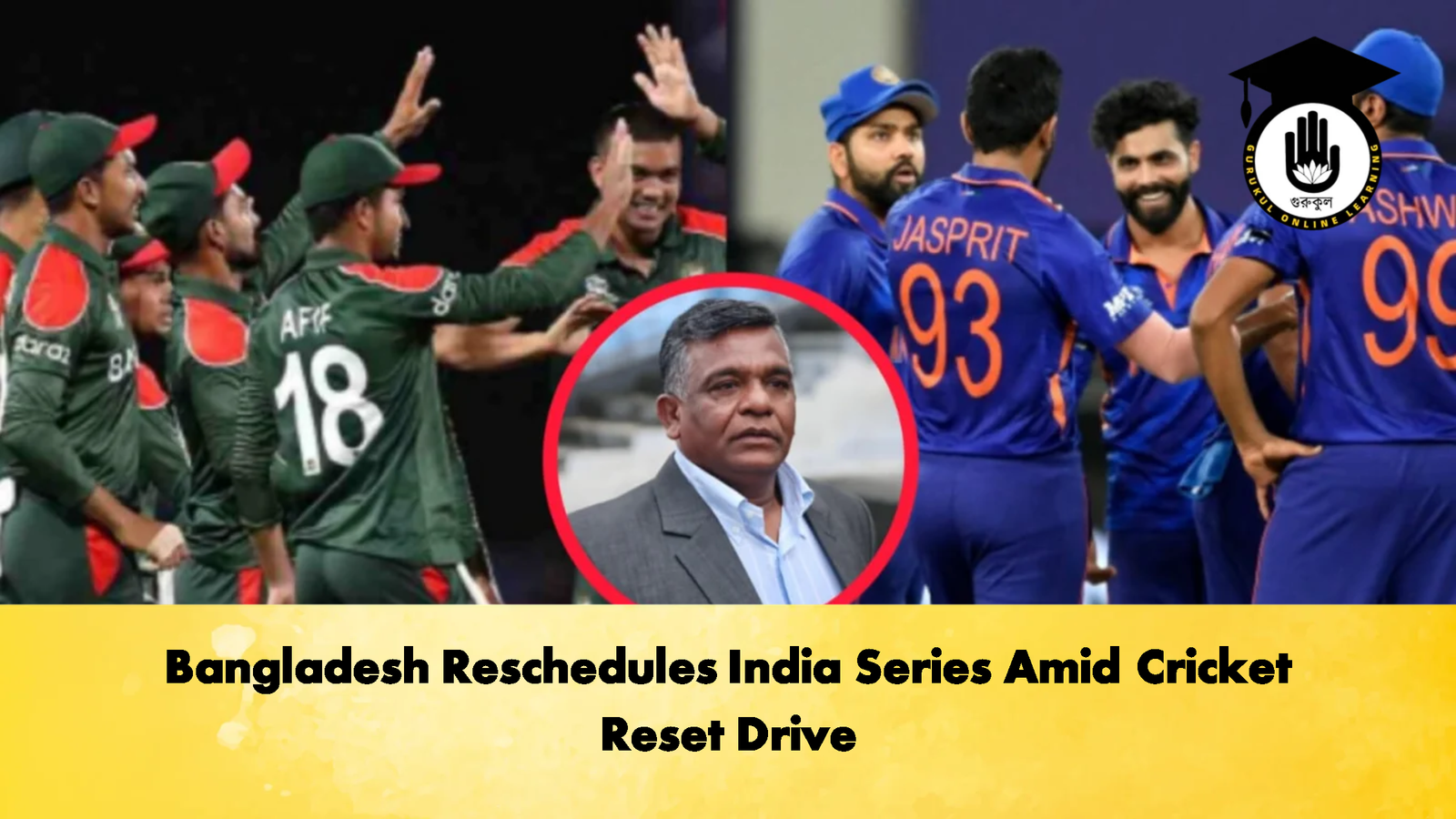
The Bangladesh Cricket Board (Bangladesh Cricket Board) has confirmed that its postponed bilateral series against India has been formally rescheduled, marking a significant step in stabilising international cricket relations and restoring continuity in its Future Tours Programme commitments.
The announcement comes in the wake of a period of unease within Bangladesh cricket, partly triggered by controversy surrounding Mustafizur Rahman linked to the Indian Premier League (IPL). The episode generated widespread debate within cricketing circles and created administrative discomfort, with knock-on effects reportedly extending to broader planning for major international assignments, including preparations linked to the T20 World Cup cycle.
In response, the BCB has taken diplomatic and administrative steps to normalise relations with the Board of Control for Cricket in India (Board of Control for Cricket in India). This includes formal written communication aimed at easing tensions, clarifying scheduling commitments, and reaffirming long-standing bilateral agreements under the Future Tours Programme (FTP).
Series Rescheduling and Bilateral Dialogue
BCB Cricket Operations Chairman Nazmul Abedin Fahim confirmed that the previously postponed India series—originally scheduled for last year—has now been repositioned within the revised international calendar.
He stressed that communication between the two cricket boards remains structured, continuous, and professional, with regular engagement on scheduling coordination, player availability, and long-term bilateral planning. According to him, the rescheduling reflects normal FTP adjustments rather than any breakdown in relations.
Meanwhile, BCB Cricket Operations in-charge Shahriar Nafees reinforced that bilateral fixtures are governed strictly by FTP obligations, adding that such arrangements are insulated from short-term disruptions or external controversies.
He noted that dialogue with international cricket boards, including the BCCI, remains a routine administrative process, describing it as part of standard governance rather than crisis management.
National Team Preparations Intensify
On the sporting front, the Bangladesh national team is currently engaged in an intensive training camp in Mirpur under the supervision of the BCB. The camp is designed to build foundational fitness before transitioning into more advanced technical and tactical preparation phases.
Coaching staff have placed strong emphasis on strength and conditioning, with gradual integration of batting, bowling, and fielding drills as players adapt to workload demands. Particular attention is also being given to managing training intensity under hot and humid conditions.
Training Camp Overview
| Area of Preparation | Focus | Current Status |
|---|---|---|
| Fitness Training | Strength and endurance | High-intensity phase ongoing |
| Skill Development | Batting and bowling drills | Gradually increasing workload |
| Fielding Practice | Reflex, agility, coordination | Integrated into sessions |
| Environmental Adaptation | Heat and humidity management | Players adjusting well |
Positive Assessment of Progress
Speaking on the camp’s progress, Shahriar Nafees said that players have shown strong discipline and commitment throughout the training phase. He added that sessions have been well-structured, with noticeable improvements in intensity, focus, and execution.
He also expressed optimism that the preparation programme will remain on track ahead of the upcoming New Zealand series, despite challenging weather conditions. According to him, players are adapting efficiently and maintaining consistency in training outputs.
Strengthening Global Cricket Coordination
The BCB’s recent engagement with the BCCI and other international boards forms part of a broader strategy to ensure stability in Bangladesh’s global cricket calendar. By maintaining steady communication channels and reaffirming FTP commitments, the board aims to reduce scheduling uncertainty and strengthen long-term bilateral cooperation.
Cricket analysts argue that such coordination is increasingly vital in modern international cricket, where congested calendars demand careful workload management and precise scheduling alignment across formats and series.
As Bangladesh continues its preparations for upcoming international fixtures, the focus remains on rebuilding competitive rhythm, enhancing performance standards, and maintaining smooth administrative relations with key cricketing nations, including India and New Zealand, as part of a more stable and structured cricketing roadmap.