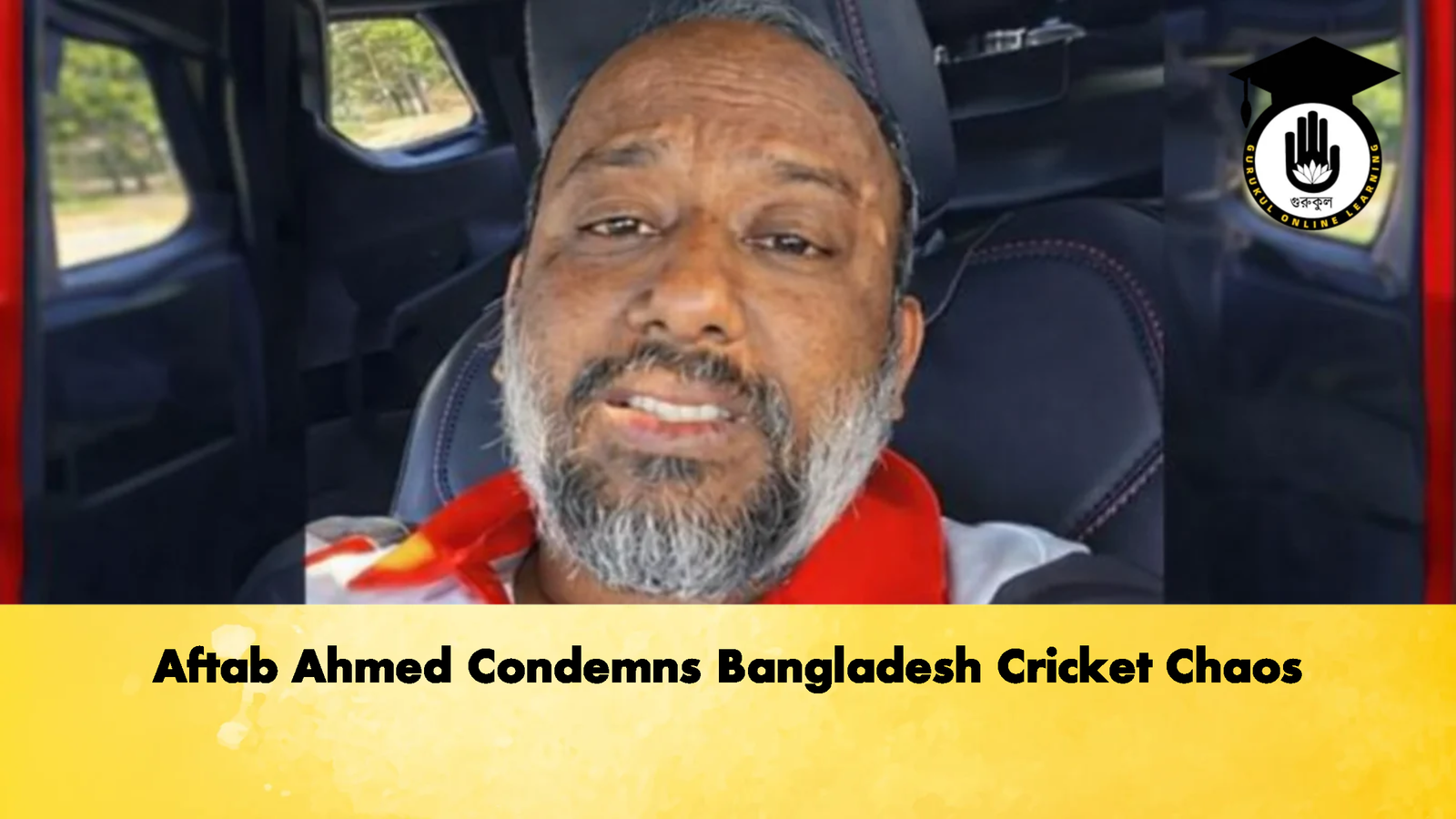
Bangladesh cricket has once again been engulfed in controversy following renewed administrative instability within its governing structure, the Bangladesh Cricket Board (BCB). Former national opener Aftab Ahmed has issued a sharp critique of the situation, describing the ongoing turbulence as a “circus” and questioning the repeated leadership changes that have unsettled the sport since last year’s political transition.
The crisis began after the political shift on 5 August 2024, which marked the end of the long-standing tenure of former BCB president Nazmul Hassan Papon. His departure closed more than a decade of continuity at the top of the board but ushered in a phase of rapid and repeated administrative reshuffles.
Within approximately 20 months, Bangladesh cricket has seen three separate leadership transitions involving Faruk Ahmed, Aminul Islam Bulbul, and former national captain Tamim Iqbal, highlighting an unusually unstable governance period in the country’s cricket history.
The latest development came when the National Sports Council (NSC) dissolved Bulbul’s committee, citing alleged irregularities in the BCB election process. In its place, an 11-member ad hoc committee led by Tamim Iqbal has taken over the operational responsibilities of the board.
Table of Contents
ToggleRecent Leadership Changes in BCB
| Period | Leadership | Position |
|---|---|---|
| Pre–August 2024 (10+ years) | Nazmul Hassan Papon | BCB President |
| Post–political transition | Faruk Ahmed | Interim leadership role |
| Subsequent phase | Aminul Islam Bulbul | Committee head |
| Current structure | Tamim Iqbal | Head of 11-member ad hoc committee |
Aftab Ahmed’s Strong Remarks
Speaking in a video message shared on social media, Aftab Ahmed—considered one of Bangladesh’s earliest hard-hitting top-order batters—expressed deep frustration over the ongoing instability.
Now based in the United States, he compared Bangladesh cricket administration to a public spectacle, suggesting that the situation has deteriorated to the point where governance resembles entertainment. He remarked that even purchasing a ticket would not be wasted, as the unfolding developments themselves constitute a “performance”.
He went on to describe the current state of affairs as the “biggest circus” in the country’s sporting landscape, citing repeated leadership changes and ongoing controversies as key concerns.
Comparison with Cricket Governance in the United States
Drawing on his experience living and working in the United States, Aftab contrasted the visibility of cricket administration in Bangladesh with what he described as the relative obscurity of governing structures in America.
He noted that during his three years in the United States, he has had little awareness of the internal organisation or personnel of the local cricket governing body. However, he stressed that this lack of visibility has not hindered his involvement in cricket development activities.
According to him, while ignorance of administrative details in the United States might be viewed as a personal limitation, in Bangladesh the situation is the opposite—where governance matters are constantly in the public eye due to extensive media coverage and political scrutiny.
“No One Can Claim Ignorance”
Aftab further argued that in Bangladesh, no stakeholder can realistically claim ignorance of cricket administration, as developments within the BCB are continuously amplified by media reporting. He suggested that even those who do not actively follow cricket governance remain exposed to it due to its high-profile nature in public discourse.
He criticised the recurring cycle of instability and questioned how long such disruptions could continue without meaningful structural reform.
Concerns Over Long-Term Stability
The remarks highlight broader concerns about institutional continuity within Bangladesh cricket at a time when leadership changes, election disputes, and the creation of ad hoc committees have become increasingly frequent.
With the BCB now operating under an interim structure led by Tamim Iqbal, questions persist over long-term planning, governance transparency, and administrative stability. Analysts and stakeholders alike warn that unless structural reforms are introduced, the ongoing cycle of disruption could undermine the sport’s development and international competitiveness.