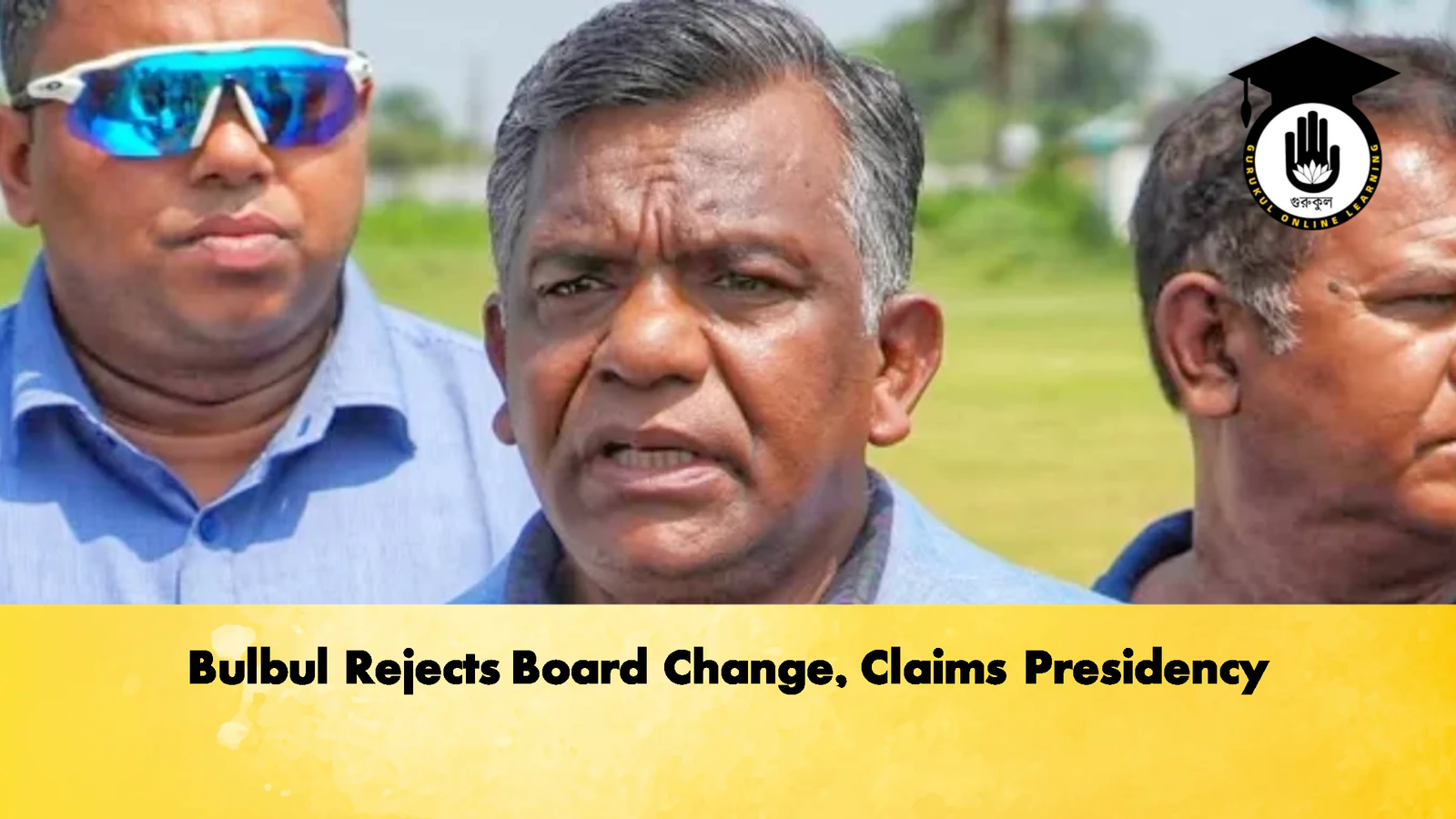
Former Bangladesh captain Aminul Islam Bulbul has declared himself the “only legitimate president” of the Bangladesh Cricket Board (BCB), while branding the newly formed ad-hoc committee led by Tamim Iqbal as “unconstitutional and illegal”, intensifying the deepening governance crisis in Bangladesh cricket.
His remarks came shortly after the National Sports Council (NSC) announced the dissolution of the current BCB board and the formation of an interim ad-hoc committee. In a strongly worded statement issued on Tuesday (7 April), Bulbul also dismissed the NSC’s investigative report as legally flawed and procedurally invalid.
The escalating dispute has created parallel claims of authority within the country’s top cricket governing body, raising serious concerns over administrative stability ahead of upcoming international commitments.
Key competing claims
| Issue | Bulbul’s position | NSC / Ad-hoc committee position |
|---|---|---|
| BCB presidency | Claims he remains the “only legitimate president” | Board dissolved; interim committee formed |
| Ad-hoc committee | Declared illegal and unconstitutional | Established under NSC directive |
| 2025 election | Fully valid and transparent | Under review by NSC investigation |
| Legal authority | Constitution and ICC independence rules | Government sports authority decision |
Defence of 2025 election process
In his statement, Bulbul defended the Bangladesh Cricket Board election held on 6 October 2025, describing it as fully transparent and conducted in accordance with constitutional procedures. He said the election was supervised by a three-member commission led by senior Supreme Court lawyer Advocate Mohammad Hossain.
The commission also included Additional Inspector General of Police Sibgat Ullah and a then senior executive director of the National Sports Council, he noted.
Bulbul further argued that objections relating to the participation of 15 clubs and the councillorship of Tamim Iqbal were resolved through quasi-judicial hearings held on 24 and 25 September 2025, prior to the election. As such, he insisted that there was no legal basis to challenge the validity of the electoral outcome.
Allegations of overreach and political influence
Bulbul strongly criticised the NSC’s recent intervention, describing it as “ultra vires” and politically motivated. He alleged that the inquiry process initiated under Youth and Sports Adviser Aminul Haque was designed to dismantle an elected board rather than ensure regulatory compliance.
He further argued that under the constitution of the International Cricket Council (ICC), member boards are required to operate free from government interference. In this context, he described the current situation as a “constitutional coup” that undermines cricket governance in Bangladesh.
Rejection of ad-hoc committee authority
Rejecting the legitimacy of the newly formed ad-hoc committee headed by former captain Tamim Iqbal, Bulbul stated that his faction does not recognise its authority. He asserted that until a final ruling is delivered by the High Court, he remains the duly elected and lawful head of the Bangladesh Cricket Board.
Call for ICC intervention
Expressing concern over the broader implications of the crisis, Bulbul warned that ongoing instability could damage Bangladesh cricket’s international reputation and undermine investor confidence in the sport’s governance structure.
He also highlighted potential risks to the development pathway of young cricketers if administrative uncertainty continues.
Calling for urgent intervention, he urged the International Cricket Council (ICC) to step in and help resolve the dispute, arguing that the matter threatens the autonomy and stability of Bangladesh cricket administration.
Symbolic inspection amid crisis
Earlier on the same day, Bulbul, accompanied by former Bangladesh wicketkeeper Khaled Masud Pilot, visited the Bangladesh Cricket Board’s facilities in Purbachal, an act widely seen as a symbolic assertion of authority amid the escalating leadership conflict.
Deepening governance standoff
The dispute now places Bangladesh cricket in an unprecedented administrative standoff, with rival factions claiming legitimacy and legal authority. With court proceedings expected and political scrutiny increasing, the resolution of the crisis is likely to shape the future governance structure of one of the country’s most influential sporting institutions.