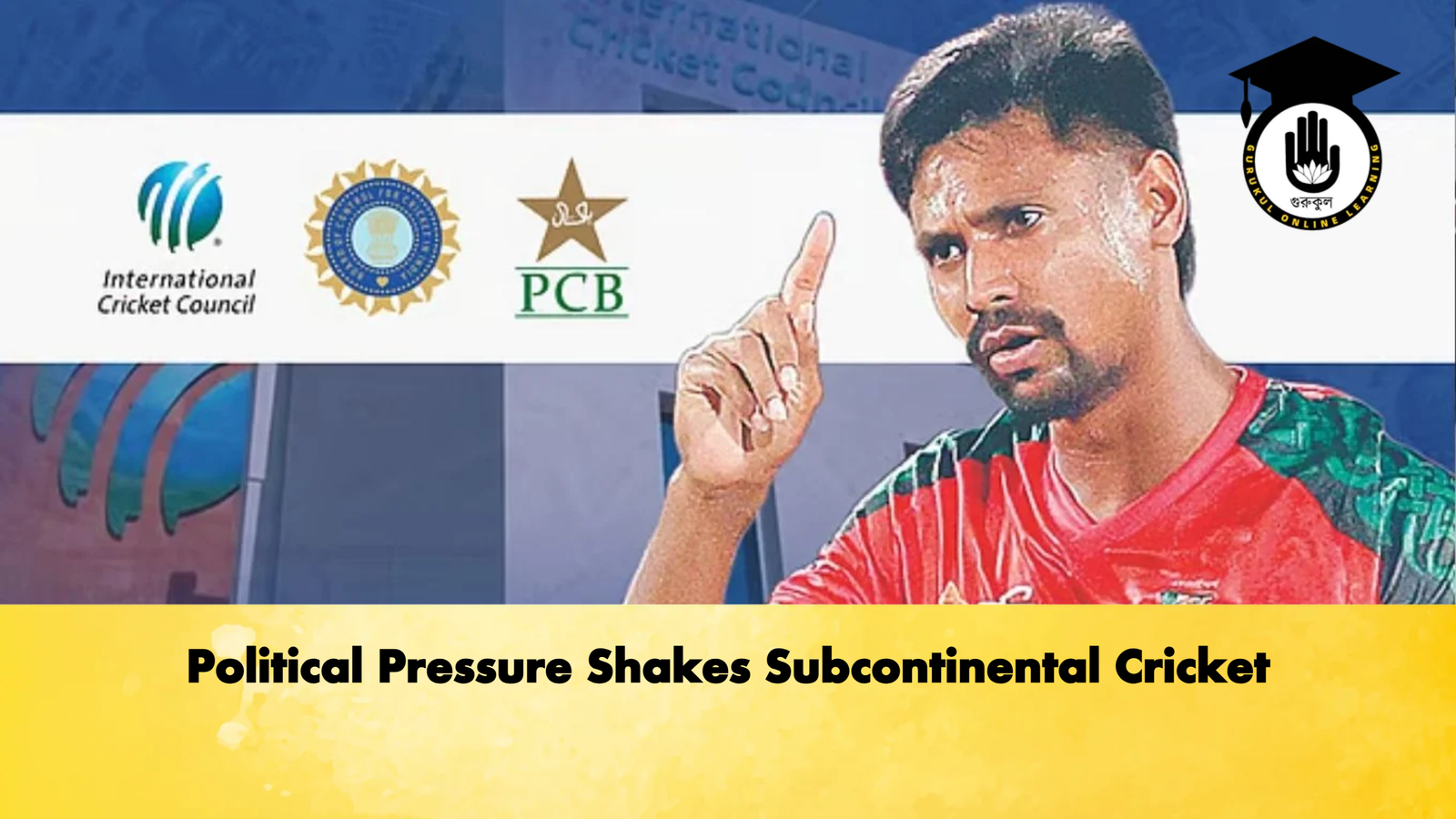
Last year, on 16 December, Bangladesh’s pace bowler Mustafizur Rahman made headlines when Kolkata Knight Riders secured his services at a record-breaking 92 million Indian Rupees during the Indian Premier League (IPL) auction. This sum marked the highest-ever purchase of a Bangladeshi cricketer in the history of the tournament, sparking waves of excitement and pride among cricket fans across Bangladesh. Mustafizur’s acquisition was celebrated not only as a personal triumph but as a landmark achievement for Bangladeshi cricket on the global stage.
However, the celebrations were short-lived. On 3 January 2025, following mounting pressure from certain extremist groups in India, the Board of Control for Cricket in India (BCCI) instructed Kolkata Knight Riders to release Mustafizur from the team. This episode underscored the unsettling reality that political influence—whether exerted by an individual or a group—can penetrate even the most prominent sporting leagues, reshaping their trajectory and decision-making.
The consequences rapidly extended beyond the IPL. Bangladesh’s Twenty20 team, alongside the ICC World Cup, felt the repercussions. Citing security and political concerns, Bangladesh refused to play its scheduled matches in India, ultimately resulting in its exclusion from the T20 World Cup. Pakistan followed suit, withdrawing from matches against India. These decisions caused significant financial setbacks for the ICC and the host nations, highlighting the fragile intersection of sport, politics, and economics.
The financial impact of these developments is summarised below:
| Issue | Amount | Details |
|---|---|---|
| Mustafizur’s IPL contract | 92 million INR | Kolkata Knight Riders |
| Potential India–Pakistan match market | 500 million USD (~61.2 billion BDT) | Estimated commercial and broadcasting revenue |
| Bangladesh’s T20 World Cup absence | 3.3 billion BDT | Loss of ICC income and spectator engagement |
Experts have described the Mustafizur controversy as a “domino effect”: a seemingly isolated incident—a player being dropped from a domestic league—spiralling into global financial losses and political entanglements. Mustafizur’s release triggered the cancellation of high-profile India–Pakistan fixtures, Bangladesh’s exclusion, and widespread revenue losses for the ICC.
Former ICC Head of Communications Sami-ul-Hasan remarked, “Had Kolkata Knight Riders been privately informed, and the issue managed discreetly without media exposure, the situation would not have escalated so severely.”
The incident reflects an increasingly complex reality in South Asian cricket. While bat and ball remain central, political and financial pressures are reshaping the sport, often at the cost of impartiality and enjoyment. Today’s cricket is no longer solely a game—it is a delicate blend of politics, commerce, and public sentiment.