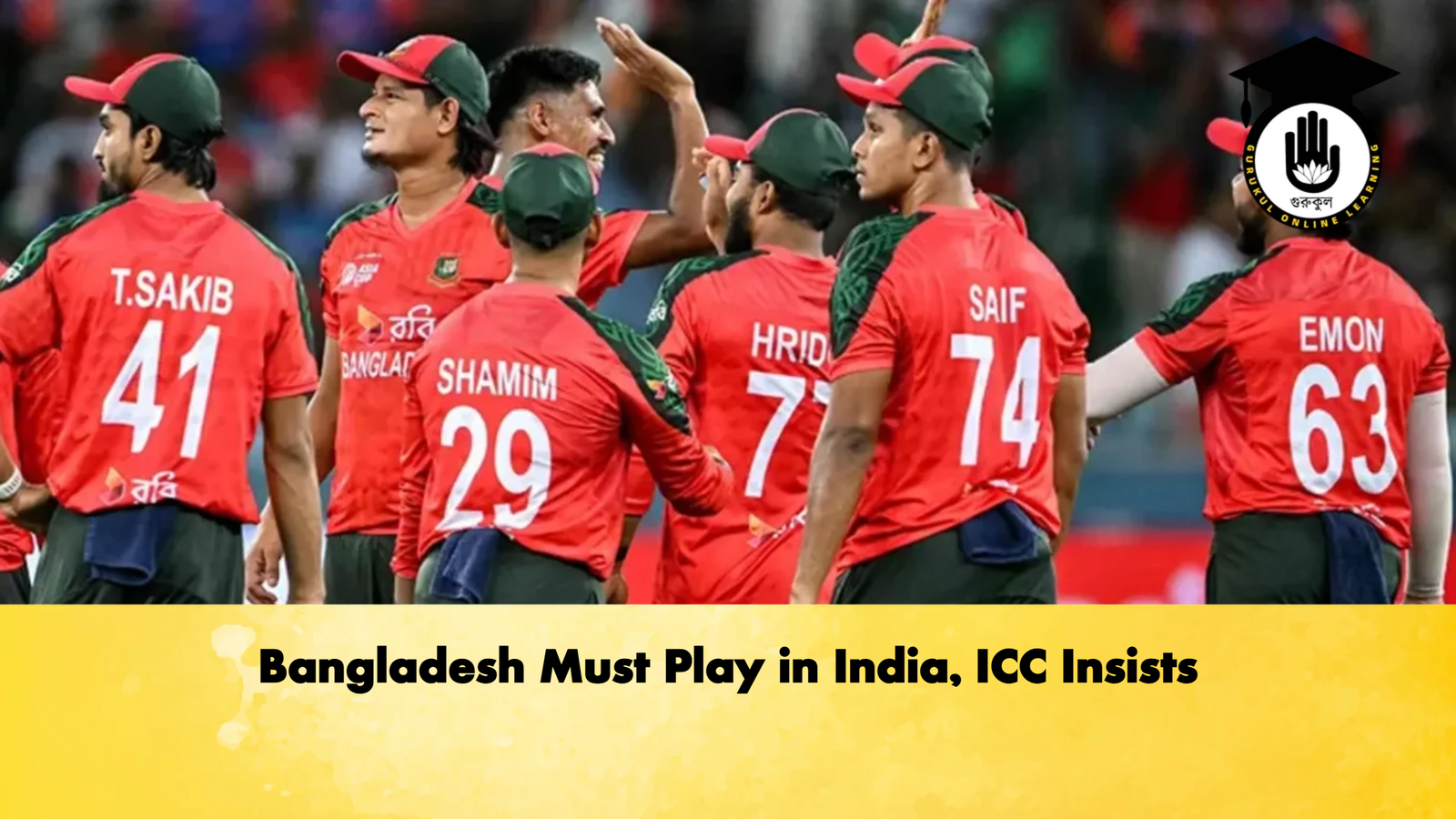
The International Cricket Council (ICC) has taken an uncompromising stance ahead of the forthcoming ICC Men’s T20 World Cup, formally informing the Bangladesh Cricket Board (BCB) that Bangladesh must travel to India to fulfil its scheduled fixtures. Following a full ICC board meeting, the governing body issued an official statement making it clear that there will be no change to the designated host venues. Bangladesh has been given a strict 24-hour deadline to confirm its participation under the existing arrangements, failing which a replacement team will be drafted into Group C.
The decision has placed the BCB under intense pressure. On Wednesday night, senior board officials held an emergency meeting with Bangladesh’s sports adviser to determine the next course of action. The meeting continued late into the night, reflecting the gravity of the situation and the far-reaching implications of any potential withdrawal from the tournament. Several former players and administrators have warned that opting out of a global event of this magnitude could expose Bangladesh cricket to long-term sporting, financial and diplomatic consequences.
Bangladesh’s reluctance to play in India stems from concerns over security. Citing safety considerations, the BCB had earlier communicated its unwillingness to compete on Indian soil and proposed relocating its matches to Sri Lanka. In response, the ICC engaged in multiple rounds of dialogue with the BCB, including dispatching senior officials to Dhaka in an effort to reach a compromise. Despite these efforts, the BCB maintained its position.
With no resolution in sight, the ICC convened an emergency board meeting involving all 12 Full Member nations. After extensive deliberations, the matter was put to a vote. Bangladesh’s proposal failed to attract support from either Full Members or Associate Members. Pakistan formally requested the ICC to give special consideration to Bangladesh’s circumstances, but the appeal did not influence the final outcome.
In its post-meeting statement, the ICC said it had conducted an exhaustive review before arriving at its decision. This included independent security assessments, venue-specific safety plans, and formal guarantees from the local organising authorities. The findings concluded that there is no credible or verifiable security threat to Bangladeshi players, officials, media personnel or supporters at any of the Indian venues.
An ICC spokesperson emphasised that the council had engaged in “continuous and constructive dialogue” with the BCB over recent weeks, with the sole objective of ensuring Bangladesh’s participation. However, the spokesperson added that the BCB continued to link World Cup participation to an isolated and unrelated issue involving a Bangladeshi player’s involvement in a domestic Indian league, which the ICC deemed irrelevant to tournament security or eligibility criteria.
Should Bangladesh decline to participate, the ICC is expected to invite a replacement side. Scotland, which narrowly missed qualification through the European pathway, has emerged as a potential candidate, although no official confirmation has been made.
Beyond sporting disappointment, non-participation could carry significant consequences for Bangladesh cricket, as outlined below:
| Area of Impact | Potential Consequences |
|---|---|
| Financial | Loss of ICC tournament revenue and shared commercial income |
| Bilateral Tours | Increased uncertainty over future inbound and outbound series |
| Governance Relations | Strained ties with other national boards |
| Cricket Development | Reduced exposure at elite global level |
Analysts believe the matter has now moved beyond the BCB and into the realm of state-level decision-making. If the government does not revise its position on playing in India, Bangladesh’s absence from the World Cup appears increasingly likely. Such a decision could leave a lasting imprint on the country’s cricketing future, affecting scheduling, relationships and its standing within the international game.